
How to Calculate Hours Worked on a Time Card
Add up a time card the way payroll does: subtract breaks, handle night shifts, convert minutes to decimal hours and apply your state’s overtime rule.
By The Xilfy Team 4 min read
 Try it: Time Card Calculator
Add up clock-in and clock-out times for the week, with state overtime and pay
Checking your paycheck, filling in a timesheet or paying someone by the hour all start with the same question: how many hours were actually worked? It sounds easy until you hit a lunch break, a shift that runs past midnight or a payroll system that wants "7.75" instead of "7:45". Here's how to add up a time card step by step, the way payroll does it.
Step 1: Work out each day
Hours worked = clock-out time − clock-in time − unpaid breaks
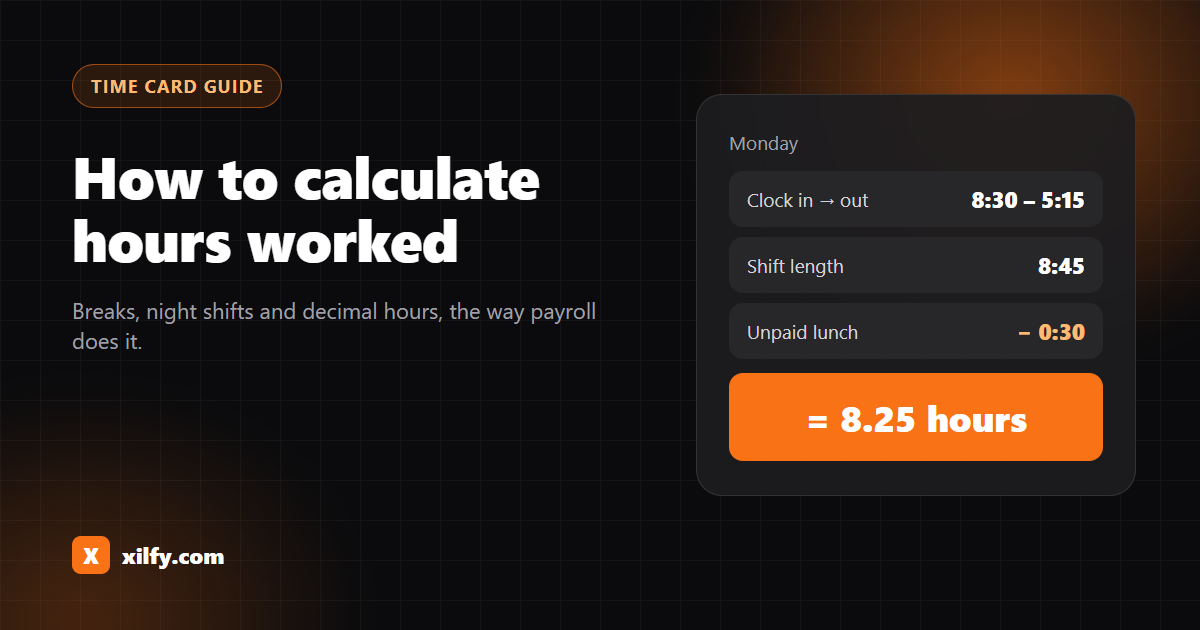
Example: you clock in at 8:30 AM, clock out at 5:15 PM and take a 30-minute unpaid lunch.
- 8:30 AM to 5:15 PM is 8 hours 45 minutes.
- Take off the 30-minute lunch: 8 hours 15 minutes.
The easiest way to subtract times is in 24-hour clock: 5:15 PM is 17:15, and 17:15 − 8:30 is 8:45. If the minutes don't go, borrow an hour: 17:15 is the same as 16:75, and 16:75 − 8:30 = 8:45.
Step 2: Convert minutes to decimal hours
Payroll multiplies hours by your hourly rate, so it needs decimals. Divide the minutes by 60:
Decimal hours = hours + (minutes ÷ 60)
8 hours 15 minutes = 8 + 15 ÷ 60 = 8.25 hours.
| Minutes | Decimal | Minutes | Decimal |
|---|---|---|---|
| 5 | 0.08 | 35 | 0.58 |
| 10 | 0.17 | 40 | 0.67 |
| 15 | 0.25 | 45 | 0.75 |
| 20 | 0.33 | 50 | 0.83 |
| 25 | 0.42 | 55 | 0.92 |
| 30 | 0.5 | 60 | 1 |
A common mistake is writing 7 hours 45 minutes as "7.45". It's 7.75, and the 0.3-hour gap costs you about 18 minutes of pay.
Step 3: Add up the week
Add the decimal hours for each day. Here's a typical week:
| Day | In | Out | Break | Hours |
|---|---|---|---|---|
| Monday | 8:30 AM | 5:15 PM | 30 min | 8.25 |
| Tuesday | 8:30 AM | 5:00 PM | 30 min | 8.00 |
| Wednesday | 8:45 AM | 6:00 PM | 30 min | 8.75 |
| Thursday | 8:30 AM | 5:30 PM | 30 min | 8.50 |
| Friday | 8:30 AM | 4:00 PM | 30 min | 7.00 |
| Total | 40.50 |
At $20 an hour that's 40 hours × $20 = $800, plus 0.5 hours of overtime at $30 = $15, so $815 for the week.
Our time card calculator does all three steps for you: enter in and out times and breaks for each day, and it shows each day's hours, the weekly total in both hours:minutes and decimals, overtime and pay. You can download it as a CSV or print it.
Shifts that go past midnight
For a night shift, count the hours to midnight and then the hours after it. 10:00 PM to 6:30 AM is 2 hours before midnight and 6.5 after, so 8.5 hours. On a time card the hours usually count on the day the shift started. Most time card calculators, including ours, handle this for you: when the clock-out time is earlier than the clock-in time, it's taken as the next morning.
Which breaks are paid?
Under federal rules:
- Short breaks of about 5 to 20 minutes are work time and must be paid. Don't subtract them.
- Meal breaks of 30 minutes or more can be unpaid, but only if you're fully relieved of duty. If you eat at your desk answering the phone, it's work time.
Some states, such as California, also require meal and rest breaks after a certain number of hours.
Time clock rounding
Many employers round punches to the nearest 5, 6 or 15 minutes. With 15-minute rounding (the "7-minute rule"), 1 to 7 minutes past the quarter hour round down and 8 to 14 round up, so a clock-in at 8:07 counts as 8:00 and one at 8:08 counts as 8:15.
Rounding is allowed under federal rules only if it's neutral, meaning it doesn't always favour the employer over time. If your punches always seem to round against you, keep your own record of the exact times.
Overtime: weekly or daily?
Under federal law, overtime is time and a half for hours over 40 in the workweek. But a few states count overtime by the day, and that changes what your time card is worth:
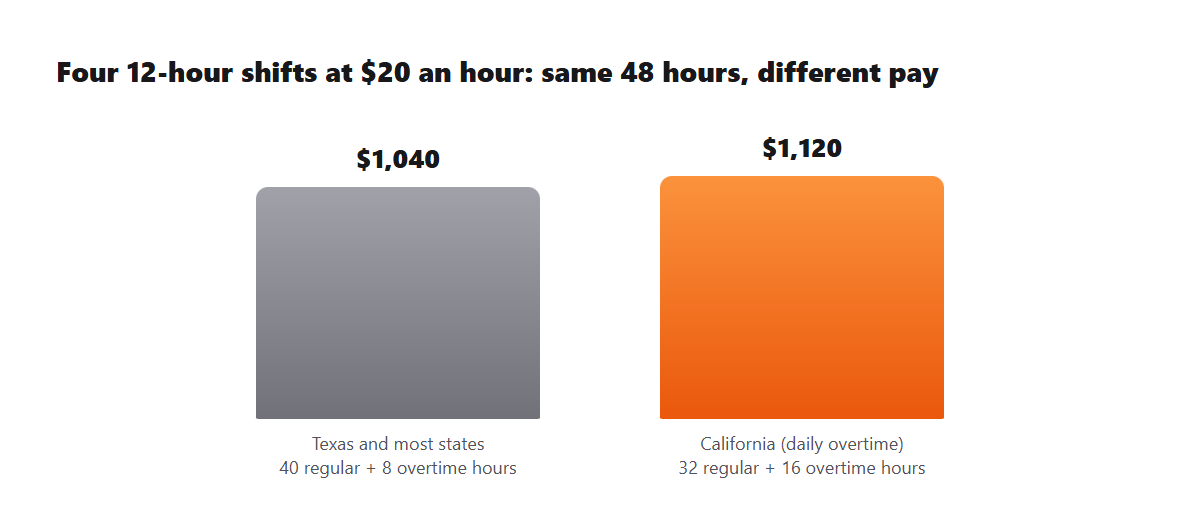
- California: overtime after 8 hours a day, double time after 12, plus a seventh-day rule.
- Alaska: overtime after 8 hours a day.
- Nevada: overtime after 8 hours a day for workers paid under $18 an hour.
- Colorado: overtime after 12 hours a day.
Pick your state in the time card calculator and it applies the right rule to each day. For a quick weekly figure, the overtime calculator splits your total hours at 40.
Frequently asked questions
How do I calculate hours worked with a lunch break?
Subtract the clock-in time from the clock-out time, then take off the unpaid lunch. 9:00 AM to 5:30 PM with a 30-minute lunch is 8 hours.
How many hours is 9 to 5?
8 hours, or 7.5 hours if you take an unpaid 30-minute lunch. 9 to 5 five days a week is 40 hours, or 37.5 with lunches.
How do I write 8 hours 20 minutes in decimal?
20 ÷ 60 = 0.33, so it's 8.33 hours.
Should I keep my own record of my hours?
Yes. Your employer must keep time records, but writing down your own in and out times each day is the best way to spot missing hours or wrong overtime on your pay stub.
Federal rules checked November 2026. State laws on breaks, rounding and overtime vary; check with your state labor department for your situation.
More guides
- How to Calculate Overtime Pay (Time and a Half Explained) The time and a half formula with worked examples, a rate chart for common wages, when overtime starts, and the four states that also pay it by the day.
- How to Calculate Gas Cost for a Road Trip The three-number formula for fuel cost, a worked example, and why your real bill usually comes in 10–15% higher than the estimate.
- What Is a Good CPS? Clicks Per Second Explained Average CPS scores, what jitter, butterfly and drag clicking can reach, and simple ways to click faster without hurting your hand.