
Concrete Mix Ratios Explained: M10, M15, M20 and M25
What 1:2:4 and M20 mean, the cement bags, sand and aggregate for 1 m³ of each grade, a slab worked from measurements to materials, and how to mix and cure it.
By The Xilfy Team 4 min read
 Try it: Cement Calculator
Bags of cement, sand, aggregate and bricks for concrete, walls and plaster
"Use 1:2:4" is the most common instruction on small building sites in South Asia, but what does it mean, and how many bags of cement does it take? This guide explains the M10, M15, M20 and M25 grades, gives the cement, sand and aggregate for one cubic meter of each, and walks through a slab from measurements to a shopping list.
What the ratio and the grade mean
A mix ratio such as 1:2:4 is the proportion of cement : sand : coarse aggregate (stone chips, khoa or gravel) by volume. One bucket of cement, two of sand, four of stone.
The grade, such as M20, is the strength the concrete should reach after 28 days of curing: M stands for mix and 20 is the strength in N/mm² (newtons per square millimetre), tested on 150 mm cubes. M20 should hold at least 20 N/mm², about 2,900 psi.
For small jobs, engineers use nominal mixes: fixed ratios that are known to reach the grade with ordinary materials.
| Grade | Mix (cement : sand : aggregate) | Typical use |
|---|---|---|
| M5 | 1 : 5 : 10 | Levelling under floors |
| M7.5 | 1 : 4 : 8 | Lean concrete under footings |
| M10 | 1 : 3 : 6 | Blinding, non-structural floors |
| M15 | 1 : 2 : 4 | Paths, simple footings, plain concrete |
| M20 | 1 : 1.5 : 3 | Reinforced slabs, beams and columns in houses |
| M25 | 1 : 1 : 2 | Heavier structural work (usually a design mix) |
Materials for 1 cubic meter of concrete
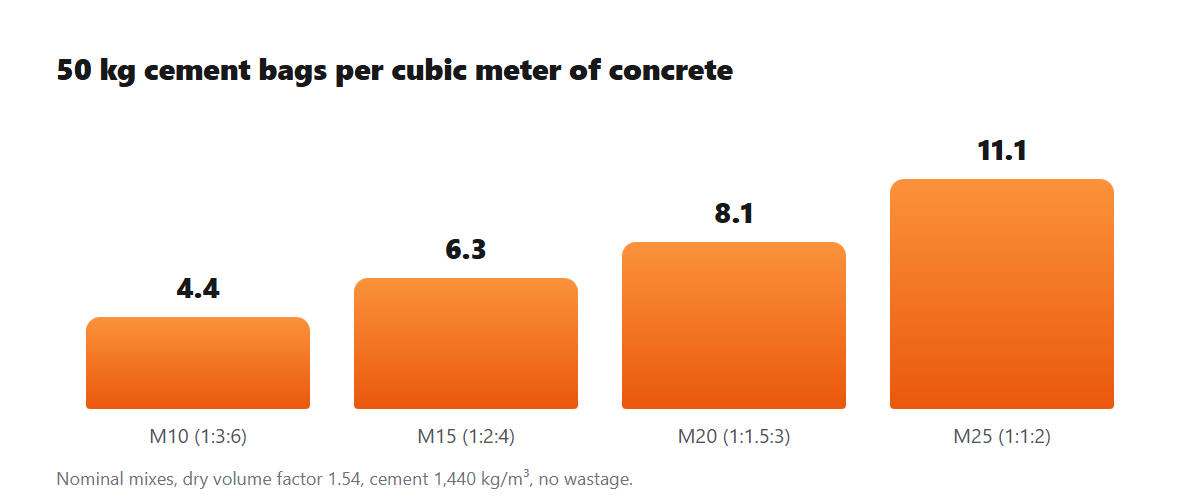
When cement, sand and stone are mixed with water, the small particles fill the gaps between the large ones, so you need more dry material than the finished volume. The usual factor is 1.54: one cubic meter of wet concrete takes about 1.54 m³ of dry materials. With cement at 1,440 kg/m³ and 50 kg bags:
| Grade | Cement | Sand | Aggregate |
|---|---|---|---|
| M10 (1:3:6) | 4.4 bags (222 kg) | 0.46 m³ (16.3 cft) | 0.92 m³ (32.6 cft) |
| M15 (1:2:4) | 6.3 bags (317 kg) | 0.44 m³ (15.5 cft) | 0.88 m³ (31.1 cft) |
| M20 (1:1.5:3) | 8.1 bags (403 kg) | 0.42 m³ (14.8 cft) | 0.84 m³ (29.7 cft) |
| M25 (1:1:2) | 11.1 bags (554 kg) | 0.39 m³ (13.6 cft) | 0.77 m³ (27.2 cft) |
How the M20 row is worked out:
- Dry volume: 1 × 1.54 = 1.54 m³
- Parts in the mix: 1 + 1.5 + 3 = 5.5
- Cement: 1.54 × 1/5.5 = 0.28 m³ × 1,440 = 403 kg = 8.1 bags
- Sand: 1.54 × 1.5/5.5 = 0.42 m³
- Aggregate: 1.54 × 3/5.5 = 0.84 m³
The cement calculator does the same for any size and grade, in meters or feet, with a wastage allowance.
Worked example: a roof slab
A slab is 20 ft × 15 ft, 5 inches thick, in M20.
- Volume: 20 × 15 × 5/12 = 125 cft = 3.54 m³
- Cement: 3.54 × 8.06 = 28.5 bags, plus 5% waste = about 30 bags
- Sand: 3.54 × 14.8 = about 53 cft
- Aggregate (20 mm stone chips): 3.54 × 29.7 = about 105 cft
- Water at a water–cement ratio of 0.5: 30 × 25 = about 750 litres, less if the sand is wet
Beams that drop below the slab add their own volume, so measure them separately and add them in.
Nominal mix or design mix?
A nominal mix is a safe recipe that assumes average materials, and it often uses more cement than needed. A design mix is worked out in a lab for the actual cement, sand, stone and water on your project, and tested on cubes. It can reach the same strength with less cement, or reliably reach higher grades.
India's concrete code, IS 456, allows nominal mixes up to M20. From M25 upwards, a design mix is the normal practice, which is why the 1:1:2 figure for M25 is only a guide. Bangladesh and Pakistan follow similar practice. For any building with more than one or two storeys, follow the mix your structural engineer specifies.
Water: the part people get wrong
Strength depends on the water–cement ratio, the weight of water divided by the weight of cement. For reinforced work it's usually 0.45 to 0.55, so a 50 kg bag needs about 22 to 27 litres, including the moisture already in the sand.
Extra water makes concrete easier to pour and much weaker: going from 0.5 to 0.7 can cut the 28-day strength by roughly a third. If the mix is too stiff to place, ask about a plasticiser rather than adding water.
Mixing, placing and curing
- Mix dry first. Turn the cement and sand together until the colour is even, add the stone, then add water gradually.
- Use it within about 30 to 45 minutes of adding water, before it starts to set.
- Compact it with a vibrator or by rodding to remove air pockets, especially around reinforcement.
- Cure it. Keep the concrete wet for at least 7 days with ordinary Portland cement and 10 days with blended cements or in hot, dry weather. Ponding water on a slab or covering it with wet hessian works well. Concrete that dries out early never reaches its grade.
FAQ
What is the mix ratio of M20 concrete? 1 : 1.5 : 3, one part cement to one and a half parts sand and three parts aggregate, by volume.
How many bags of cement are in 1 m³ of M20 concrete? About 8 bags of 50 kg as a nominal mix.
What is the ratio for M25? 1 : 1 : 2 is often quoted, but M25 is normally made as a design mix, so the exact proportions come from a mix design for your materials.
How much does 1 cubic foot of concrete need? For M20, about 0.23 bags of cement, 0.42 cft of sand and 0.84 cft of aggregate, since one cubic meter is 35.3 cubic feet.
More guides
- Why Tracking Your Baby’s Growth Matters: A Parent’s Guide What weight, length and head size tell your doctor, normal growth by month on the WHO charts, how to read percentiles and when a change is worth a call.
- How Long to Thaw a Turkey: Times by Weight and a Thanksgiving Schedule USDA fridge and cold-water thaw times for 8 to 24 lb turkeys, the day to move yours to the fridge for Thanksgiving dinner, cooking from frozen and what to do if it’s still icy.
- How Many Bricks Per Square Foot? 5-Inch and 10-Inch Walls Bricks per sq ft and per m² for 5-inch and 10-inch walls with Bangladeshi, Indian and Pakistani bricks, plus cement and sand for the mortar and a worked room example.