
Why Tracking Your Baby’s Growth Matters: A Parent’s Guide
What weight, length and head size tell your doctor, normal growth by month on the WHO charts, how to read percentiles and when a change is worth a call.
By The Xilfy Team 6 min read
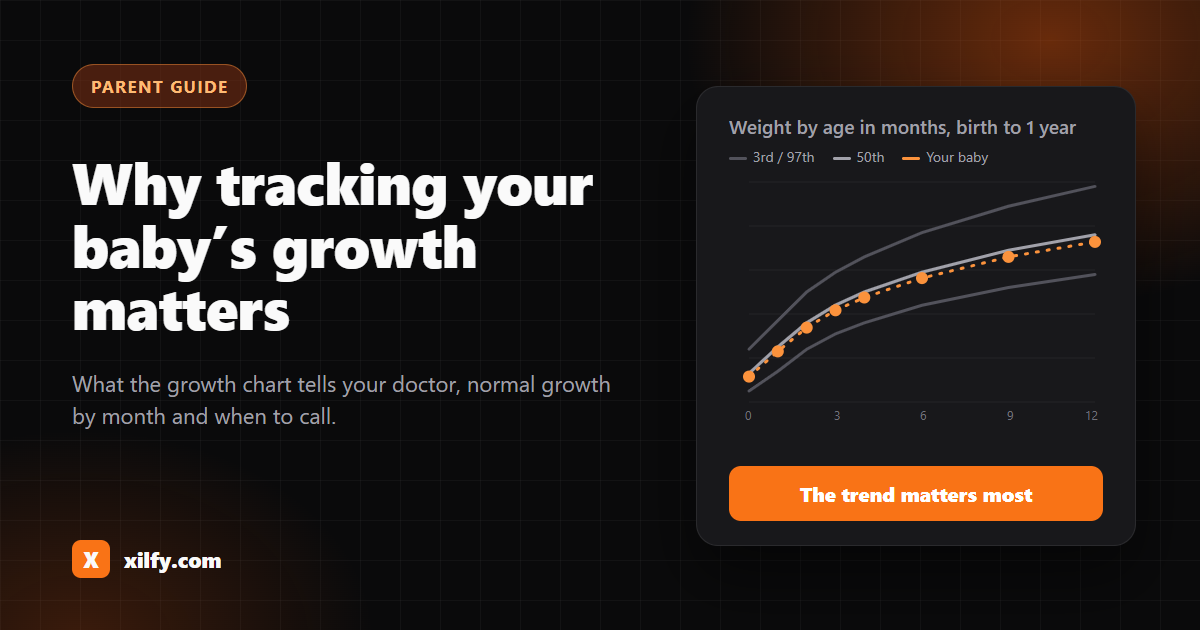 Try it: Baby Growth Percentile Calculator
WHO growth chart percentiles for weight, length and head, birth to 5 years
At every check-up, your baby is weighed, measured and has their head measured, and the numbers go onto a growth chart. It can feel like a routine box to tick, but for a baby who can't tell you how they feel, steady growth is one of the clearest signs that they are feeding well and healthy. Here's what those measurements show, what is normal, and when a change is worth a call to your doctor.
Why growth tells doctors so much
Babies grow faster in their first year than at any other time after birth. Almost everything that affects their health shows up in that growth sooner or later:
- Feeding. Slow weight gain is often the first sign that a baby isn't getting enough milk, because of latch problems, a low milk supply, reflux or a formula that doesn't suit them.
- Illness. Infections, food allergies, heart, kidney or thyroid problems, and trouble absorbing food (such as coeliac disease later in childhood) can all slow growth before other signs appear.
- Brain growth. Head circumference follows the growth of the brain. A head that grows much too slowly or too fast is a reason for a closer look.
- Healthy weight later. Weight that climbs much faster than length over many months can be an early sign that a child is heading towards being overweight.
Around the world, growth checks matter on a much larger scale too. WHO and UNICEF estimate that about 150 million children under 5 are stunted, meaning too short for their age because of long-term poor nutrition or illness, and more than 40 million are wasted, meaning too thin for their height. Regular measuring is how health workers spot these children early, while help still makes the most difference.
What normal growth looks like
Every baby has their own pace, but most follow a familiar pattern:
- The first days: newborns lose some weight after birth, often 5 to 7% and up to about 10%, then usually regain their birth weight by about 2 weeks.
- 4 to 5 months: many babies have roughly doubled their birth weight.
- 12 months: birth weight has roughly tripled, length has gone up by about half, and the head has grown by about 11 to 12 cm.
- After the first birthday: growth slows down a lot. Toddlers gain only about 2 to 3 kg in their second year, which is why many eat less than parents expect.
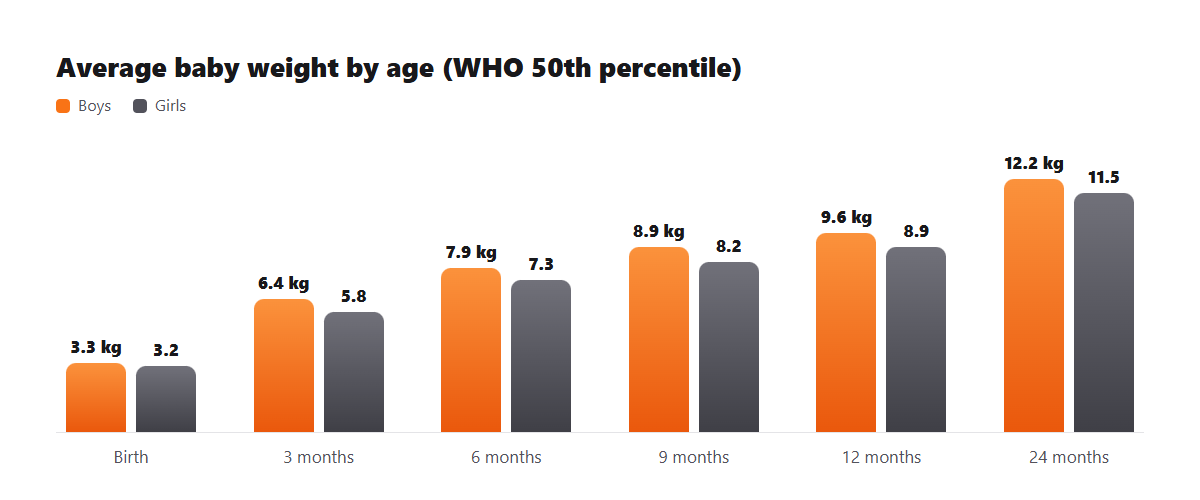
These are the middle values (the 50th percentile) from the WHO Child Growth Standards, with the usual range from the 3rd to the 97th percentile in brackets:
| Age | Boys' weight | Girls' weight | Boys' length | Girls' length |
|---|---|---|---|---|
| Birth | 3.3 kg (2.5–4.4) | 3.2 kg (2.4–4.2) | 49.9 cm | 49.1 cm |
| 3 months | 6.4 kg (5.1–7.9) | 5.8 kg (4.6–7.4) | 61.4 cm | 59.8 cm |
| 6 months | 7.9 kg (6.4–9.7) | 7.3 kg (5.8–9.2) | 67.6 cm | 65.7 cm |
| 9 months | 8.9 kg (7.2–10.9) | 8.2 kg (6.6–10.4) | 72.0 cm | 70.1 cm |
| 12 months | 9.6 kg (7.8–11.8) | 8.9 kg (7.1–11.3) | 75.7 cm | 74.0 cm |
| 24 months | 12.2 kg (9.8–15.1) | 11.5 kg (9.2–14.6) | 87.1 cm | 85.7 cm |
The range is wide on purpose. A healthy baby can sit anywhere in it, and a small baby of small parents is usually just following their family's build.
Percentiles: the line matters more than the dot
A percentile compares your baby with 100 healthy babies of the same age and sex. At the 25th percentile for weight, 25 of those babies weigh less and 75 weigh more. It isn't a score, and a higher number is not better.
What doctors watch most is the shape of the line over several check-ups. Most babies settle onto one percentile curve and stay close to it. A few signs make them look more closely:
- a measurement below the 3rd or above the 97th percentile;
- a line that drops or climbs across two of the main percentile lines (such as from the 50th to below the 9th or 10th);
- weight that falls behind length, or races ahead of it;
- a head circumference that crosses lines quickly in either direction.
One low reading on its own rarely means much. Scales differ, a baby may have just fed or had a wet diaper, and length is hard to measure on a wriggling baby. That is why a trend over several visits tells the real story.
How often babies are measured
In the United States, the American Academy of Pediatrics recommends check-ups in the first days after birth, then at 1, 2, 4, 6, 9, 12, 15, 18, 24 and 30 months and once a year from age 3. Weight, length and head size are measured at each one until the second birthday. Other countries use similar schedules through health visitors, clinics or child health cards.
For babies under 2, doctors in most countries, including the CDC in the United States, use the WHO growth charts, which are based on healthy breastfed babies growing in good conditions. For a baby born before 37 weeks, growth is plotted by corrected age, counted from the due date, until about age 2.
Checking growth at home
You can keep your own record between visits with our Baby Growth Percentile Calculator. It uses the same WHO charts, and the numbers stay in your browser. If you do, a few habits make the numbers more useful:
- Don't weigh too often. Daily weights jump around with feeds and diapers. Once a week is plenty unless your doctor asks for more.
- Use the same scale at the same time of day, with your baby naked or in a dry diaper (nappy).
- Be careful with the "hold the baby" method. Weighing yourself with and without the baby is only accurate to a few hundred grams, which is a lot for a newborn.
- Measure length with two people: one keeps the head still against a flat surface while the other straightens the legs.
- Write down where the measurement came from, home or clinic, so you compare like with like.
When to call your doctor or health visitor
Growth checks are there to catch problems early, so it's always fine to ask. Get in touch if:
- your newborn isn't back to their birth weight by about 2 weeks;
- from about day 5, your baby has fewer than six wet diapers a day, seems sleepy and hard to wake for feeds, or feeds very poorly;
- weight stays the same or drops between two measurements a few weeks apart;
- the line on the chart falls across two percentile lines;
- the head seems to be growing fast or the soft spot on top bulges, or the head stays much smaller than expected.
Seek urgent help straight away if your baby has signs of dehydration (a dry mouth, no wet diaper for many hours, a sunken soft spot), is floppy or unusually drowsy, or has a fever under 3 months of age.
The short version
Growth is your baby's quiet health report. Single numbers matter less than the curve they make over time, a wide range is normal, and the check-ups are there to catch small problems before they become big ones. Keep the records, ask questions when something worries you, and remember that your doctor knows your baby's full picture.
This article is general information, not medical advice. Always talk to your doctor, nurse or health visitor about your own baby's growth.
More guides
- How Long to Thaw a Turkey: Times by Weight and a Thanksgiving Schedule USDA fridge and cold-water thaw times for 8 to 24 lb turkeys, the day to move yours to the fridge for Thanksgiving dinner, cooking from frozen and what to do if it’s still icy.
- How Many Bricks Per Square Foot? 5-Inch and 10-Inch Walls Bricks per sq ft and per m² for 5-inch and 10-inch walls with Bangladeshi, Indian and Pakistani bricks, plus cement and sand for the mortar and a worked room example.
- How Much Does YouTube Pay Per View? Real Numbers for 1,000 to 1 Million Views What creators really earn per view, per 1,000 views and per million views, why RPM matters more than CPM, why Shorts pay so little, and how to work out your own figure.