
How Many Bricks Per Square Foot? 5-Inch and 10-Inch Walls
Bricks per sq ft and per m² for 5-inch and 10-inch walls with Bangladeshi, Indian and Pakistani bricks, plus cement and sand for the mortar and a worked room example.
By The Xilfy Team 4 min read
 Try it: Cement Calculator
Bags of cement, sand, aggregate and bricks for concrete, walls and plaster
Before you order bricks for a house, a boundary wall or a room extension, you need two numbers: how many bricks, and how much cement and sand to lay them. This guide gives the rule-of-thumb counts for 5-inch and 10-inch walls with Bangladeshi, Indian and Pakistani bricks, then shows how to work out an exact order for your own wall.
Quick answer
With a 10 mm (about ⅜ inch) mortar joint:
| Wall | Bricks per sq ft | Bricks per m² | Bricks per 100 sq ft |
|---|---|---|---|
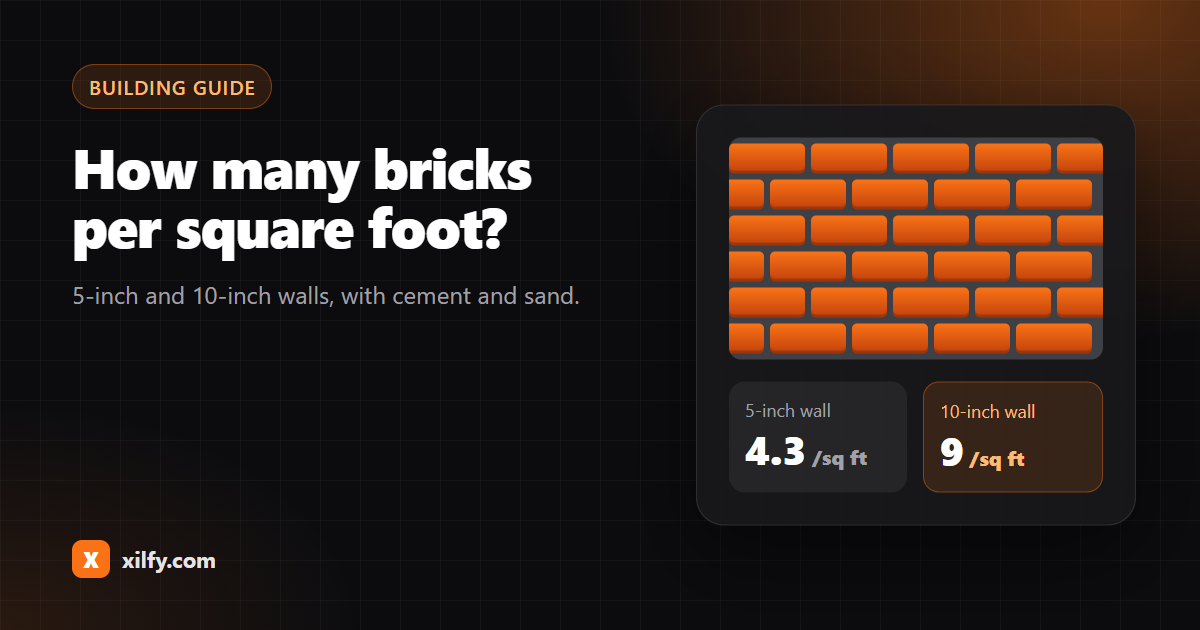
| 5-inch wall (half brick) | about 4.3 | about 46 | about 430 |
| 10-inch wall (one brick) | about 9 | about 96 | about 900 |
Add 5% to 10% for broken bricks and cutting. These figures are for Bangladeshi bricks (240 × 115 × 70 mm). Other sizes give slightly different counts, shown below.
Why the wall thickness doubles the count
A 5-inch wall is one brick thick laid lengthwise (stretcher bond). Its thickness is the brick's width, about 4.5 inches, which becomes roughly 5 inches with plaster. It's used for partitions inside a frame structure.
A 10-inch wall is two bricks thick, or bricks laid across the wall (English or Flemish bond). It's about 9.5 to 10 inches before plaster and is used for outside walls and walls that carry loads in smaller buildings.
So a 10-inch wall needs about twice the bricks and twice the mortar of a 5-inch wall of the same area.
Bricks per square foot by country
| Brick size | Common in | 5-inch / 4.5-inch wall | 10-inch / 9-inch wall |
|---|---|---|---|
| 240 × 115 × 70 mm | Bangladesh | 4.3 per sq ft | 8.9 per sq ft |
| 190 × 90 × 90 mm (modular) | India | 4.2 per sq ft | 8.8 per sq ft |
| 228 × 114 × 76 mm (9 × 4½ × 3 in) | Pakistan | 4.2 per sq ft | 8.4 per sq ft |
The counts look similar because the countries' standard bricks are close in size once the mortar joint is added. Older Indian bricks (230 × 110 × 70 mm) are thinner than modular ones, so a wall in those needs a few more.
The method: volume ÷ brick volume with mortar
Every estimate works the same way:
- Work out the wall volume. Length × height × thickness. A 20 ft × 10 ft wall, 10 inches thick, is 20 × 10 × 10/12 = 166.7 cubic feet, or 4.72 m³.
- Subtract openings. Take away doors and windows. One 3 ft × 7 ft door in that wall removes 3 × 7 × 10/12 = 17.5 cft, leaving 149.2 cft (4.22 m³).
- Find the volume of one brick with mortar. For a 240 × 115 × 70 mm brick and a 10 mm joint, use 250 × 125 × 80 mm = 0.0025 m³. That's 400 bricks per cubic meter of wall.
- Divide. 4.22 m³ × 400 = 1,690 bricks.
- Add waste. 1,690 × 1.05 = about 1,775 bricks. Order 1,800.
The cement calculator does this in its Brick wall mode: choose the brick size, enter the wall in feet or meters, and it gives bricks, cement bags and sand.
Cement and sand for the mortar
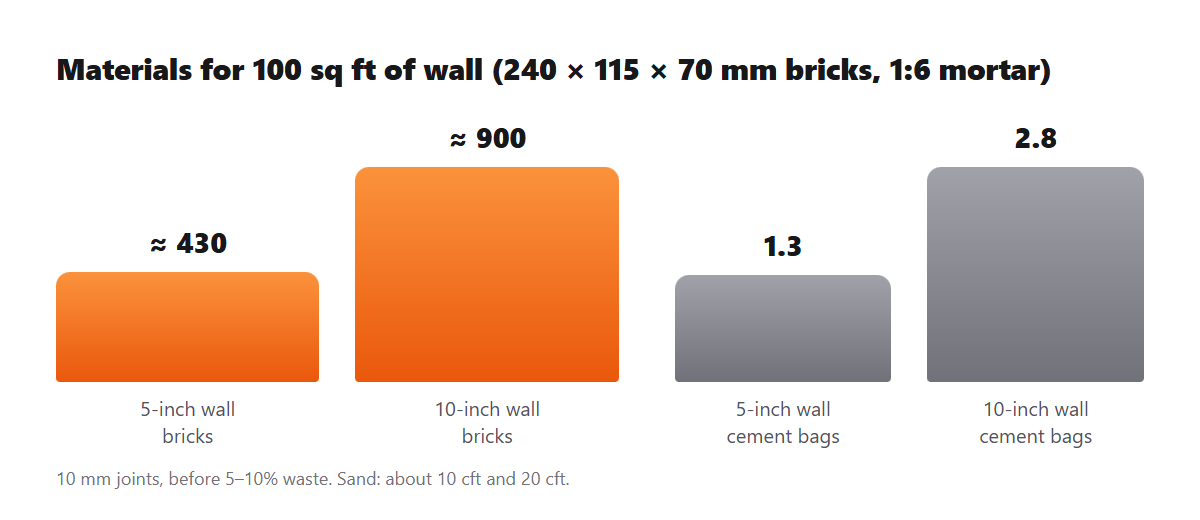
About a quarter of a brick wall's volume is mortar. Because dry sand and cement shrink when mixed with water, the wet mortar volume is multiplied by about 1.33 to get the dry materials. For a common 1:6 cement–sand mortar:
| Per 100 sq ft of wall | 5-inch wall | 10-inch wall |
|---|---|---|
| Bricks | about 430 | about 900 |
| Cement (50 kg bags) | about 1.3 | about 2.8 |
| Sand | about 10 cft | about 20 cft |
Richer mortars use more cement: 1:4 needs about 40% more cement than 1:6. Load-bearing walls and walls exposed to rain usually use 1:4 or 1:5; partitions use 1:6.
Worked example: a room
A room is 12 ft × 10 ft with walls 10 ft high. The outer walls are 10-inch brick, with one door (3 × 7 ft) and two windows (4 × 4 ft).
- Wall length around the room: 2 × (12 + 10) = 44 ft
- Wall area: 44 × 10 = 440 sq ft
- Openings: 21 + 16 + 16 = 53 sq ft
- Net wall area: 387 sq ft
- Bricks: 387 × 9 = about 3,480, plus 5% = about 3,650 bricks
- Cement for 1:6 mortar: 3.87 × 2.8 = about 11 bags
- Sand: 3.87 × 20 = about 77 cft
Corners are counted twice when you measure each wall from the outside, which adds a few extra bricks; most builders accept that as part of the waste allowance.
Tips that save money on site
- Soak the bricks for a few hours before laying. Dry bricks suck water out of the mortar and weaken the joint.
- Check a sample of bricks: good first-class bricks are evenly burnt, ring when struck together, and don't break when dropped from about a metre.
- Keep joints near 10 mm. Thick joints use more cement and make the wall weaker.
- Order in one batch if you can. Bricks from different kilns vary in size and colour.
- Count lintels and beams. Concrete over doors and windows replaces some brickwork, so a large building needs a few percent fewer bricks than the plain wall area suggests.
FAQ
How many bricks are in 1 cubic foot of brickwork? About 11 with Bangladeshi bricks and a 10 mm joint, since 1 m³ (35.3 cft) holds about 400.
How many bricks are needed for a 10 × 10 ft wall? About 430 for a 5-inch wall and about 900 for a 10-inch wall, before waste.
How many bricks are in 1 m³ of brickwork? About 400 with 240 × 115 × 70 mm bricks, about 500 with Indian modular bricks (190 × 90 × 90 mm), and about 395 with 9 × 4½ × 3 inch bricks.
Should plaster be included in the wall thickness? No. Measure the brickwork itself, and work out plaster separately by area and thickness.
More guides
- How Much Does YouTube Pay Per View? Real Numbers for 1,000 to 1 Million Views What creators really earn per view, per 1,000 views and per million views, why RPM matters more than CPM, why Shorts pay so little, and how to work out your own figure.
- How to Calculate Hours Worked on a Time Card Add up a time card the way payroll does: subtract breaks, handle night shifts, convert minutes to decimal hours and apply your state’s overtime rule.
- How to Calculate Overtime Pay (Time and a Half Explained) The time and a half formula with worked examples, a rate chart for common wages, when overtime starts, and the four states that also pay it by the day.