
How to Calculate Overtime Pay (Time and a Half Explained)
The time and a half formula with worked examples, a rate chart for common wages, when overtime starts, and the four states that also pay it by the day.
By The Xilfy Team 4 min read
 Try it: Overtime Calculator
Time and a half and double time pay for the week, with every state’s overtime rule
Worked more than 40 hours this week? If you're paid by the hour, most of those extra hours should be paid at time and a half. The math is simple once you know the two rules: what counts as overtime, and what rate it's paid at. This guide walks through both, with worked examples and the states that pay overtime by the day as well as by the week.
The formula
Overtime rate = hourly pay × 1.5 Overtime pay = overtime hours × overtime rate
Then add your regular pay for the first 40 hours:
Weekly pay = (40 × hourly pay) + (overtime hours × hourly pay × 1.5)
A worked example
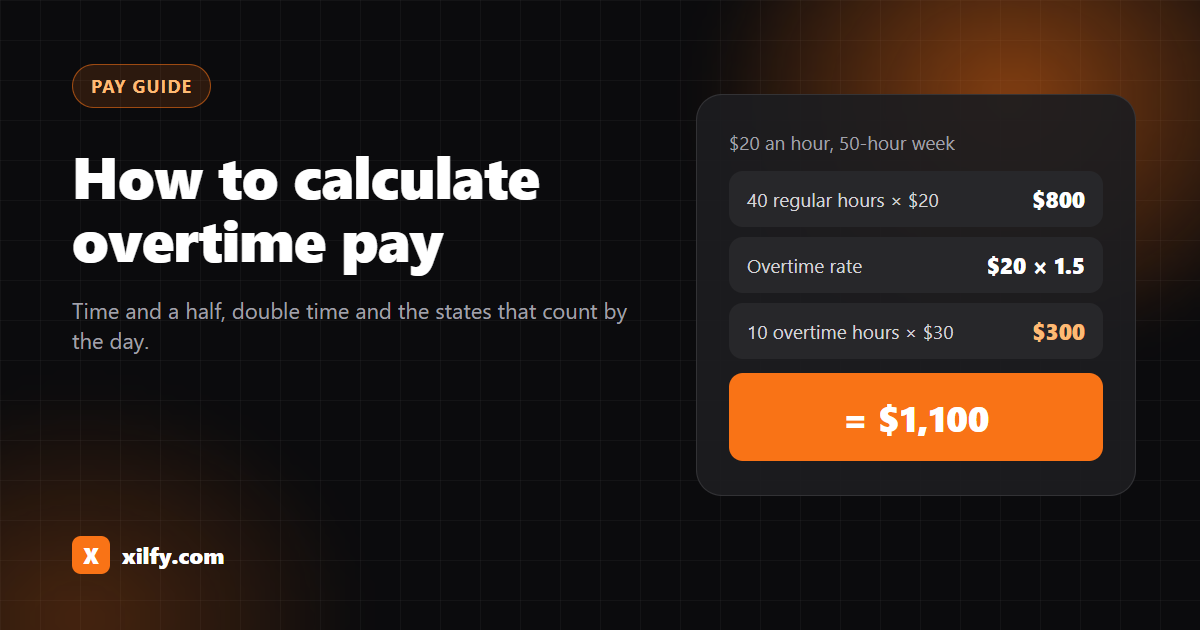
Say you earn $20 an hour and work 50 hours this week.
- Regular pay: 40 × $20 = $800
- Overtime rate: $20 × 1.5 = $30 an hour
- Overtime pay: 10 × $30 = $300
- Total: $800 + $300 = $1,100 before tax
Those 10 extra hours add $300, not $200, and they bring your average for the week up to $22 an hour.
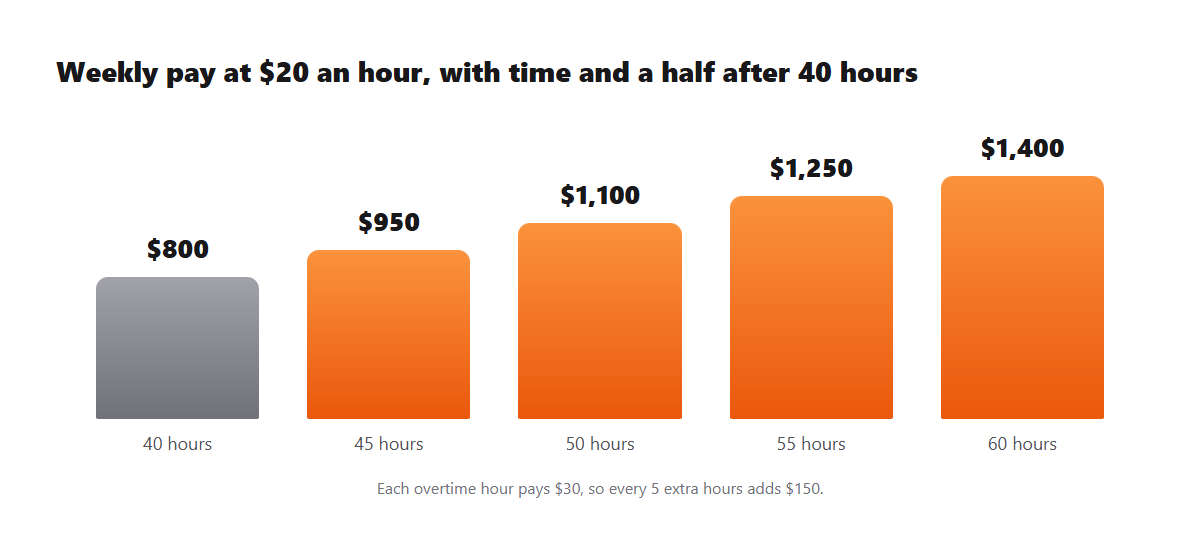
Our overtime calculator does this for any rate and number of hours, and adds double-time hours if you have them.
Time and a half for common wages
| Hourly pay | Time and a half | Double time |
|---|---|---|
| $7.25 (federal minimum) | $10.875 | $14.50 |
| $15 | $22.50 | $30 |
| $18 | $27 | $36 |
| $20 | $30 | $40 |
| $25 | $37.50 | $50 |
| $30 | $45 | $60 |
A quick way to do it in your head: halve your hourly pay and add it back. Half of $24 is $12, so time and a half is $36.
When does overtime start?
Under the federal Fair Labor Standards Act (FLSA), hourly employees get overtime for every hour over 40 in a workweek. A few details matter:
- The workweek is fixed. It's any 7 days in a row your employer sets, such as Sunday to Saturday. You can't average two weeks: 30 hours one week and 50 the next means 10 hours of overtime, not zero.
- Only hours worked count. Paid holidays, vacation and sick days don't count toward the 40 under federal law, unless your employer's policy says they do.
- Long days alone don't count in most states. Working 12 hours on Monday only matters if your week goes over 40.
States with daily overtime
Four states also count hours per day:
| State | Overtime after | Double time |
|---|---|---|
| California | 8 hours a day or 40 a week | After 12 hours a day, and after 8 hours on the 7th day in a row |
| Alaska | 8 hours a day or 40 a week | Not required |
| Nevada | 8 hours a day (if paid under $18/hour) or 40 a week | Not required |
| Colorado | 12 hours a day or 40 a week | Not required |
In these states, four 12-hour shifts at $20 an hour can pay more than in a weekly-only state, even though it's the same 48 hours. In California, each 12-hour day has 4 hours of overtime, so the week pays $1,120 instead of $1,040. You can see your own state's rule on its page, such as the California overtime calculator or the Texas overtime calculator.
To apply daily overtime, you need each day's hours, not just the weekly total. The time card calculator takes your clock-in and clock-out times and splits every day into regular, overtime and double-time hours.
What's in your "regular rate"
Overtime is 1.5 times your regular rate, which can be more than your base pay. Under federal rules it includes most:
- shift differentials (such as extra pay for nights),
- non-discretionary bonuses (such as attendance or production bonuses),
- commissions.
It doesn't include gifts, discretionary bonuses, expense repayments or pay for time not worked. If you earn a bonus that you were promised for hitting a target, your employer may owe you a little extra overtime on it.
Who doesn't get overtime?
Exempt employees aren't owed overtime by law. They're mainly salaried workers whose job passes the executive, administrative or professional duties tests, plus some outside sales, computer and farm jobs. Being paid a salary alone doesn't make you exempt: many salaried employees are non-exempt and must still get overtime.
Is overtime taxed more?
No. Overtime is taxed at the same rates as the rest of your pay. A bigger paycheck can have more tax withheld, because payroll treats it as if you earned that much every week, but it evens out when you file. From 2025 to 2028, many workers can also deduct up to $12,500 a year ($25,000 for joint filers) of the extra "half" of their overtime pay on their federal tax return.
Frequently asked questions
How do I calculate time and a half?
Multiply your hourly pay by 1.5. At $20 an hour that's $30 an hour, so 10 overtime hours pay $300.
Is overtime after 8 hours a day?
Only in a few states: California, Alaska and Nevada (for lower-paid workers), and Colorado after 12 hours. Everywhere else, overtime starts after 40 hours in the workweek.
Does my employer have to pay double time?
Federal law never requires double time. California does after 12 hours in a day and after 8 hours on the seventh day in a row. Some employers and union contracts pay it for holidays.
Can my employer give me time off instead of overtime pay?
Private employers generally can't swap overtime pay for "comp time" later. Some public sector employers can, under special rules.
This guide covers federal and state minimums for non-exempt employees, checked November 2026. Union contracts and employer policies can pay more. It's general information, not legal advice; your state labor department can answer questions about your job.
More guides
- How to Calculate Gas Cost for a Road Trip The three-number formula for fuel cost, a worked example, and why your real bill usually comes in 10–15% higher than the estimate.
- What Is a Good CPS? Clicks Per Second Explained Average CPS scores, what jitter, butterfly and drag clicking can reach, and simple ways to click faster without hurting your hand.
- The Schengen 90/180 Rule Explained, With Real Examples How the rolling 180-day window works, which countries count, and two worked examples so you never overstay in Europe by accident.