
The Schengen 90/180 Rule Explained, With Real Examples
How the rolling 180-day window works, which countries count, and two worked examples so you never overstay in Europe by accident.
By The Xilfy Team 5 min read
 Try it: Schengen Calculator
Schengen 90/180-day rule: days used, days left, overstays and the longest stay from a date
If you hold a US, UK, Canadian or Australian passport, you can visit most of Europe without a visa. The catch is a single rule that trips up more travellers than any other: you can spend no more than 90 days in any 180-day period in the Schengen area.
It sounds simple. It isn't, because the 180 days are not a calendar half-year. They move with you. This guide explains how the window works, walks through two real examples, and lists the mistakes we see most often.
What the 90/180 rule actually says
On any given day you are in the Schengen area, look back at the 180 days that end on that day. In that window, you may have been in the Schengen area for at most 90 days.
Three details matter:
- The day of entry and the day of exit both count as full days, even if you land at 11 pm or fly out at 6 am.
- All Schengen countries share one counter. A week in Paris and a week in Rome are 14 days on the same clock.
- The window rolls forward every day. Days from more than 180 days ago fall out of the count, which is how you earn days back.
There is no "reset" when you leave. Leaving simply stops new days being added while old ones drop away.
Which countries are in Schengen?
There are 29 Schengen countries: Austria, Belgium, Bulgaria, Croatia, Czechia, Denmark, Estonia, Finland, France, Germany, Greece, Hungary, Iceland, Italy, Latvia, Liechtenstein, Lithuania, Luxembourg, Malta, the Netherlands, Norway, Poland, Portugal, Romania, Slovakia, Slovenia, Spain, Sweden and Switzerland.
Bulgaria and Romania became full members on 1 January 2025, so days there now count.
Some places people assume are in Schengen are not. Ireland and Cyprus are in the EU but outside Schengen, and the United Kingdom is outside both. Time spent there does not use up your Schengen days. (Cyprus applies its own, separate 90-day limit.)
Example 1: one long trip
Say you arrive in Lisbon on 1 January 2026 and leave on 31 March 2026. That is exactly 90 days (31 + 28 + 31), so you have used your full allowance.
When can you come back? You need a day where the 180-day window, including the day you arrive, holds no more than 90 days. That first happens when 1 January drops out of the window, on 30 June 2026.
In other words: after a full 90-day stay, you need to stay out for roughly the next 90 days. Here that is 1 April to 29 June.
Example 2: two shorter trips
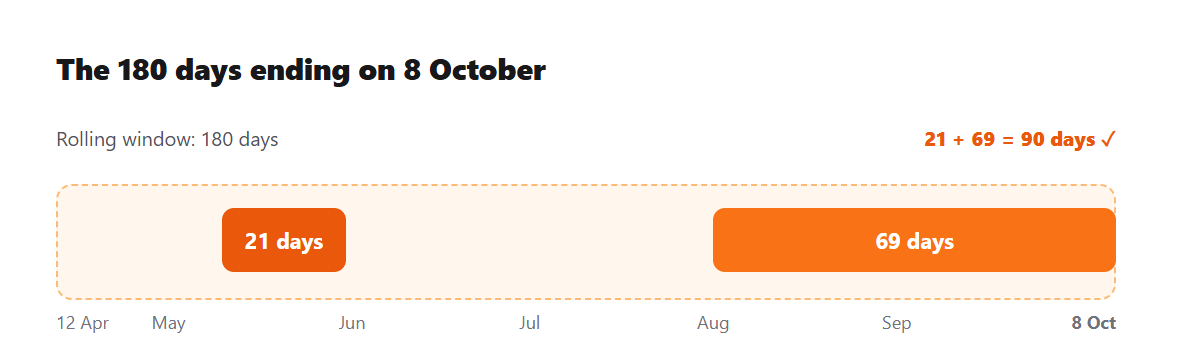
This is where people get caught out. Say you spent 10 to 30 May in Spain (21 days), and you plan to return on 1 August. How long can you stay?
Every day from your May trip is still inside the 180-day window until early November, so all 21 days still count. That leaves you 90 − 21 = 69 days. Counting 1 August as day one, your last legal day is 8 October.
If you had assumed "I was only away for two months, so I have a fresh 90 days", you would overstay by three weeks.
| Trip | Dates | Days counted |
|---|---|---|
| Trip 1 | 10–30 May | 21 |
| Trip 2 | 1 August – 8 October | 69 |
| Total in the window on 8 October | 90 |
You can check any set of dates in seconds with our Schengen calculator. Enter each trip, and it shows the days used, the days left, any overstay, and the longest you can stay from a given date.
Who the rule applies to
The 90/180 rule applies to:
- Visa-exempt visitors, including citizens of the US, the UK (since Brexit), Canada, Australia, New Zealand, Japan and many others.
- People on a short-stay Schengen visa (type C). Your visa may also allow fewer days than 90, and that lower number wins.
It does not limit EU, EEA or Swiss citizens, or people with a residence permit or a long-stay national visa for a Schengen country. Days spent under those permits count differently, so check with the country that issued yours.
A handful of older bilateral agreements between individual countries let some nationalities stay longer in that one country. They are narrow, the rules vary, and border guards do not always apply them consistently. Do not rely on one without written confirmation from that country's embassy.
How the rule is enforced now
For years, your passport stamps were the record, and counting them was your problem. That is changing. The EU's Entry/Exit System (EES) began operating in October 2025. It records your entries and exits digitally, with your fingerprints and a photo, and calculates your remaining days automatically.
The practical result: an overstay that might once have gone unnoticed is now flagged at the border. Penalties depend on the country and range from a fine to an entry ban covering the whole Schengen area.
Common mistakes
- Counting calendar months instead of days. "Three months" is not 90 days. January to March is 90 days in 2026 but 91 days in a leap year.
- Forgetting travel days. Arrive late on Friday and leave early on Sunday, and you have used three days, not one.
- Assuming a trip outside Schengen resets the clock. A weekend in London or Dublin pauses new days, but your earlier days are still in the window.
- Working it out once, at the start of the trip. If plans change, recount. The window moves every day.
Frequently asked questions
Does leaving for a day reset my 90 days?
No. There is no reset. Leaving stops new days being added, but days from the previous 180 days still count until they roll out of the window.
Does a layover in a Schengen airport count?
If you stay airside and do not pass through passport control, it usually does not count as an entry. If you go through immigration, even for a few hours, that day counts.
Can I stay 90 days, leave for one day and come back?
Not for long. On the day you return, the window still holds almost all of your previous 90 days, so you would be over the limit straight away.
Is the rule different for UK citizens after Brexit?
UK citizens now follow the same 90/180 rule as other visa-exempt visitors. Time spent in Ireland does not count, because Ireland is outside Schengen.
Rules checked against the Schengen Borders Code (Article 6) and the European Commission's guidance on short stays. This guide is general information, not legal advice. If your situation is unusual, such as dual nationality or a pending residence permit, confirm with the embassy of the country you are visiting.
More guides
- How to Calculate Gas Cost for a Road Trip The three-number formula for fuel cost, a worked example, and why your real bill usually comes in 10–15% higher than the estimate.
- US Sales Tax by State: How It Works and How to Calculate It Why the price on the shelf isn’t what you pay, which states charge the most and least, and the simple formula for any purchase.
- UK Holiday Entitlement: How Much Paid Leave Are You Owed? The 5.6-week rule in plain English, for full-time, part-time, zero-hours and irregular-hours workers, with tables and examples.