
What Is a Good CPS? Clicks Per Second Explained
Average CPS scores, what jitter, butterfly and drag clicking can reach, and simple ways to click faster without hurting your hand.
By The Xilfy Team 3 min read
 Try it: CPS Test
Click as fast as you can for 1 to 100 seconds to see your clicks per second
CPS means clicks per second: how many times you can press a mouse button in one second. It matters in games where speed decides fights, such as PvP in block-building games, and it's also a fun test to share with friends. So what counts as a good score, and how do people get faster? Here's what the numbers look like.
Typical CPS scores
| CPS | What it means |
|---|---|
| Under 5 | Relaxed clicking |
| 6–7 | Average. Most people land here with normal clicking |
| 8–10 | Fast. Good for normal clicking |
| 10–14 | Very fast. Usually takes jitter clicking |
| 15–20+ | Usually butterfly clicking (two fingers) |
| 25+ | Usually drag clicking, or a mouse with a very bouncy switch |
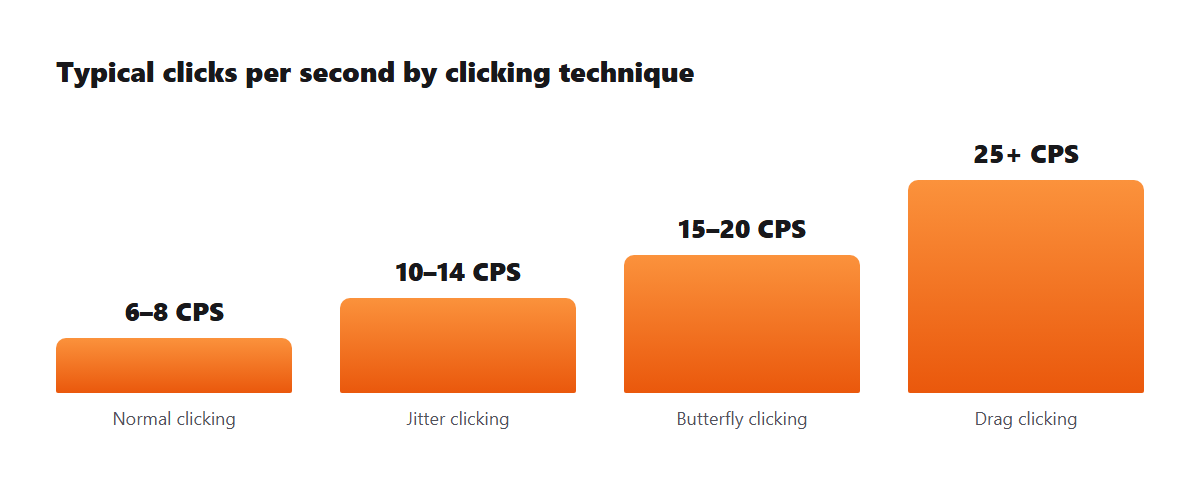
These are rough ranges. Your score also depends on how long the test lasts: almost everyone is faster over 1 or 5 seconds than over 60 seconds, because the arm tires.
You can check yours with our CPS Test. It times 1 to 100 seconds, shows your fastest single second and charts every second, so you can see when you start to slow down. The 10-second test is a good middle ground.
The four clicking techniques
Normal clicking
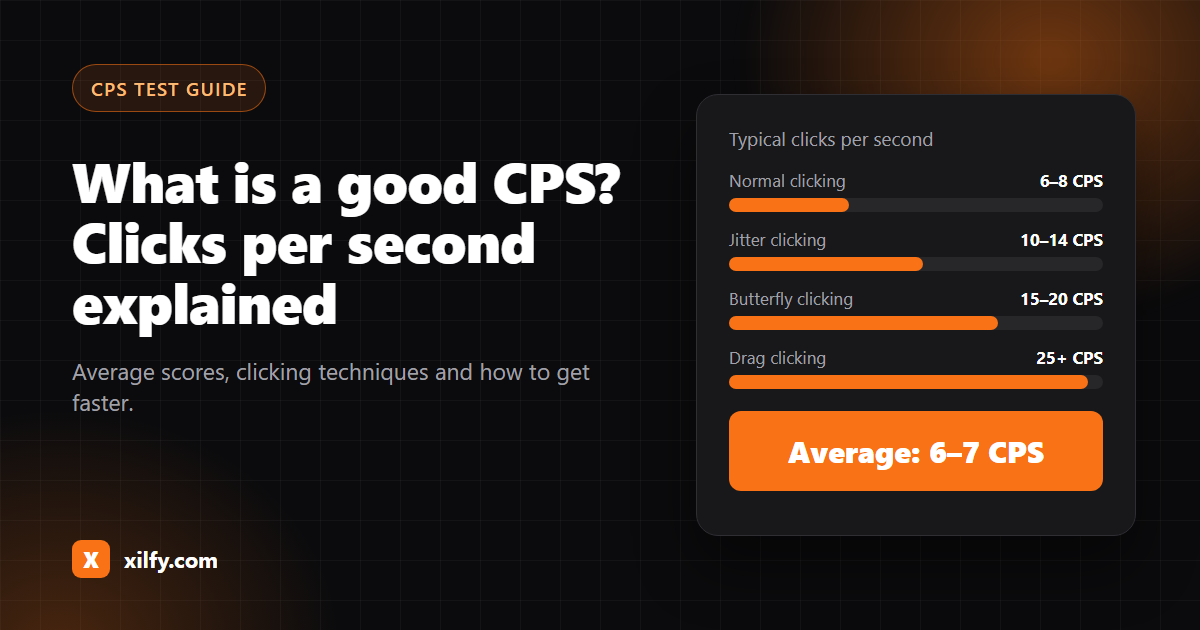
Tapping the button with one finger, the way you usually click. Most people reach 6–8 CPS. It's the most accurate technique and the easiest on your hand.
Jitter clicking
You tense the muscles in your forearm and wrist so your hand vibrates, and the finger taps the button with each shake. It can reach 10–14 CPS, but it is tiring, it makes aiming harder, and it puts strain on the arm.
Butterfly clicking
You put two fingers (usually index and middle) on the same button and tap them one after the other. Each finger only has to click half as often, so 15–20 CPS is possible. Some games and servers treat butterfly clicks as double-clicks, so check the rules first.
Drag clicking
You drag a finger slowly across the button so that the friction makes it bounce, and each bounce counts as a click. It can register 25 CPS or more in short bursts, but it depends heavily on the mouse. Rough mouse buttons work better, and many mice can't do it at all.
How to improve your CPS
- Warm up. Open and close your hand a few times first. Cold fingers are slow.
- Use the tip of your finger rather than the pad. It gives a shorter, faster press.
- Rest your arm. Keep your wrist on the desk and let your finger do the work for normal clicking.
- Practise in short sets. Do several 5- or 10-second tests rather than one long one, and watch your fastest second improve.
- Try a lighter mouse button. Some gaming mice have switches that need less force.
Look after your hands
Fast clicking techniques, especially jitter and drag clicking, can cause wrist and forearm pain if you do them for a long time. They can also wear out mouse switches faster. Take breaks, stretch, and stop if anything hurts.
Frequently asked questions
What is a good CPS?
About 6–7 CPS is average. 8–10 is fast for normal clicking, and anything above 10 usually needs a technique like jitter or butterfly clicking.
Is 10 CPS good?
Yes. 10 CPS is faster than most people manage with normal clicking, and it's plenty for most games.
Does the length of the test change my CPS?
Yes. Short tests give higher scores because you don't have time to tire. Compare scores from tests of the same length.
Can I test CPS on a phone or with the spacebar?
Yes. Our CPS test works with a touchscreen, and it has a spacebar option for testing how fast you can press a key.
CPS ranges in this guide are approximate and vary between people, mice and test lengths.
More guides
- How to Calculate Gas Cost for a Road Trip The three-number formula for fuel cost, a worked example, and why your real bill usually comes in 10–15% higher than the estimate.
- The Schengen 90/180 Rule Explained, With Real Examples How the rolling 180-day window works, which countries count, and two worked examples so you never overstay in Europe by accident.
- UK Holiday Entitlement: How Much Paid Leave Are You Owed? The 5.6-week rule in plain English, for full-time, part-time, zero-hours and irregular-hours workers, with tables and examples.