
How to Unscramble Words: Tips That Actually Work
Letter pairs, vowel tricks and blank tiles: the habits strong word game players use to unscramble letters, plus how to crack 5-letter puzzles.
By The Xilfy Team Updated 3 min read
 Try it: Word Finder
Unscramble letters into every word they make, with blanks, tile points, patterns and word lists by letter
Staring at a rack of seven tiles, or a jumble like RTSAEN, and nothing comes? Unscrambling is a skill, and a few simple habits make it much easier. This guide covers the tricks strong word game players use, how to handle blank tiles, and how to solve 5-letter guessing puzzles.
1. Look for common letter pairs first
English words are built from a small set of letter groups. Pull these out of your jumble before you try anything else:
- Endings: -ING, -ED, -ER, -EST, -LY, -S, -TION
- Beginnings: RE-, UN-, DE-, IN-, PRE-
- Pairs that often go together: TH, CH, SH, CK, QU, ST, TR, PL
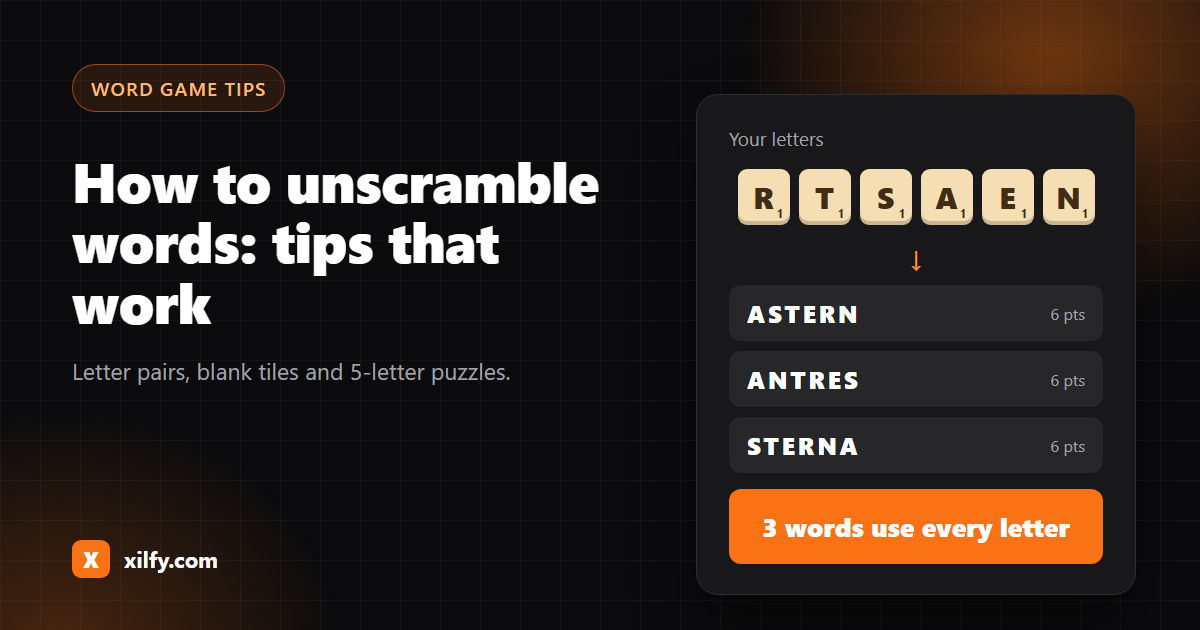
Take RTSAEN. Spot -ER or ST and the rest falls into place: ASTERN, ANTRES and STERNA all use every letter.
2. Separate vowels and consonants
Write the vowels in one row and the consonants in another. Most words alternate between them, so try building simple consonant-vowel-consonant patterns first: with B, L, T, A, E you quickly find BAT, BET, LET, TALE, BLEAT and TABLE.
3. Move the letters around
Your brain gets stuck on the order you first saw the letters in. Shuffle the tiles, write the letters in a circle, or read them backwards. A new arrangement often shows a word you missed.
4. Start short, then grow
Find any 2- or 3-letter word, then add one letter at a time: AT → EAT → TEAR → TREAT. Short words also help you place tiles next to words already on the board.
How many words are there of each length?
Most valid game words have 7 to 9 letters, but in practice the short ones matter most, because they fit almost anywhere on a board.
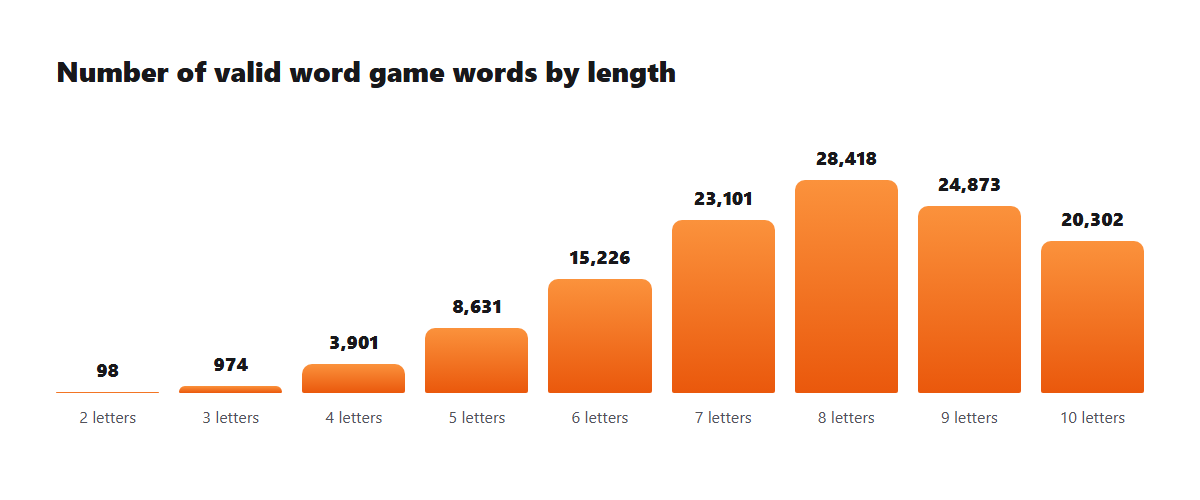
There are only 98 two-letter words, so it's worth learning them. Lists like 5-letter words and words starting with Q are good places to start.
Blank tiles
A blank can stand for any letter, but it scores zero points. Save it for:
- A long word that uses all your tiles, which usually earns a big bonus
- A hard letter you need but don't have, such as the U after a Q
- Reaching a premium square you couldn't use otherwise
In our Word Finder, type a ? for each blank (up to three) and it lists every word your tiles can make, with the points each one scores.
Solving 5-letter guessing puzzles
Daily 5-letter puzzles give you three kinds of clue. Use each one differently:
- Green letters (right letter, right place): put them in a pattern, for example ?R??E.
- Yellow letters (in the word, wrong place): add them to "must include".
- Grey letters (not in the word): add them to "leave out".
Start with a guess that has several common, different letters, such as words built from E, A, R, T, O, I, S and N. Don't reuse grey letters, and try yellow letters in new positions.
Frequently asked questions
What's the fastest way to unscramble a word?
Look for common endings and letter pairs (-ING, -ER, -ED, TH, ST) first, then arrange what's left around them. If you're still stuck, a word finder lists every option at once.
What words can I make from these letters?
Type your letters into the Word Finder. It shows every word from the longest down to two letters, with tile points.
How many 5-letter words are there?
Our list has 8,631 valid 5-letter words, of which about 5,200 are everyday words. Puzzle games usually use a shorter list of common words as answers.
Is using a word finder cheating?
In a friendly game, agree on the rules first. For learning, it's a great way to discover new words and check what you missed after a game.
Word counts come from the ENABLE word list (public domain), which our Word Finder uses for valid game words.
More guides
- How to Calculate Gas Cost for a Road Trip The three-number formula for fuel cost, a worked example, and why your real bill usually comes in 10–15% higher than the estimate.
- What Is a Good CPS? Clicks Per Second Explained Average CPS scores, what jitter, butterfly and drag clicking can reach, and simple ways to click faster without hurting your hand.
- The Schengen 90/180 Rule Explained, With Real Examples How the rolling 180-day window works, which countries count, and two worked examples so you never overstay in Europe by accident.