
Northern Lights Forecast: The Kp Index Explained
What the Kp index means, what Kp you need where you live, and the darkness, cloud and moon checks that decide whether you actually see the aurora.
By The Xilfy Team Updated 4 min read
 Try it: Northern Lights Tonight
Can you see the aurora tonight? A yes, maybe or no for your city from the NOAA Kp forecast, darkness, moon and cloud cover
An aurora forecast usually comes down to one number: the Kp index. Kp tells you how far the northern lights are likely to reach from the pole tonight. It does not tell you whether you will see them, because that also depends on darkness, cloud and the moon. This guide explains what Kp means, what Kp you need where you live, and how to judge a forecast before you head out.
What the Kp index measures
Kp is a scale from 0 to 9 that measures how disturbed Earth's magnetic field is, averaged over three-hour blocks. The US National Oceanic and Atmospheric Administration's Space Weather Prediction Center (NOAA SWPC) publishes it as a forecast for the next three days.
- Kp 0–2: quiet. The aurora stays in a ring around the far north (the auroral oval).
- Kp 3–4: active. The oval widens and moves towards the equator.
- Kp 5 and above: a geomagnetic storm, graded G1 (Kp 5) to G5 (Kp 9). Displays can reach places that rarely see the aurora.
Every step up in Kp pushes the edge of the oval roughly 2 degrees of latitude further from the pole.
Why your magnetic latitude matters
The aurora is centred on the geomagnetic pole, which sits in northern Canada, not on the North Pole. That tilts everything towards North America. A city in Canada or the northern US is "further north" magnetically than a city in Europe at the same latitude on the map. That is why Minneapolis, at about 45°N, can see the aurora more easily than Rome or Madrid, which are not far south of it on a globe.
What Kp you need where you live
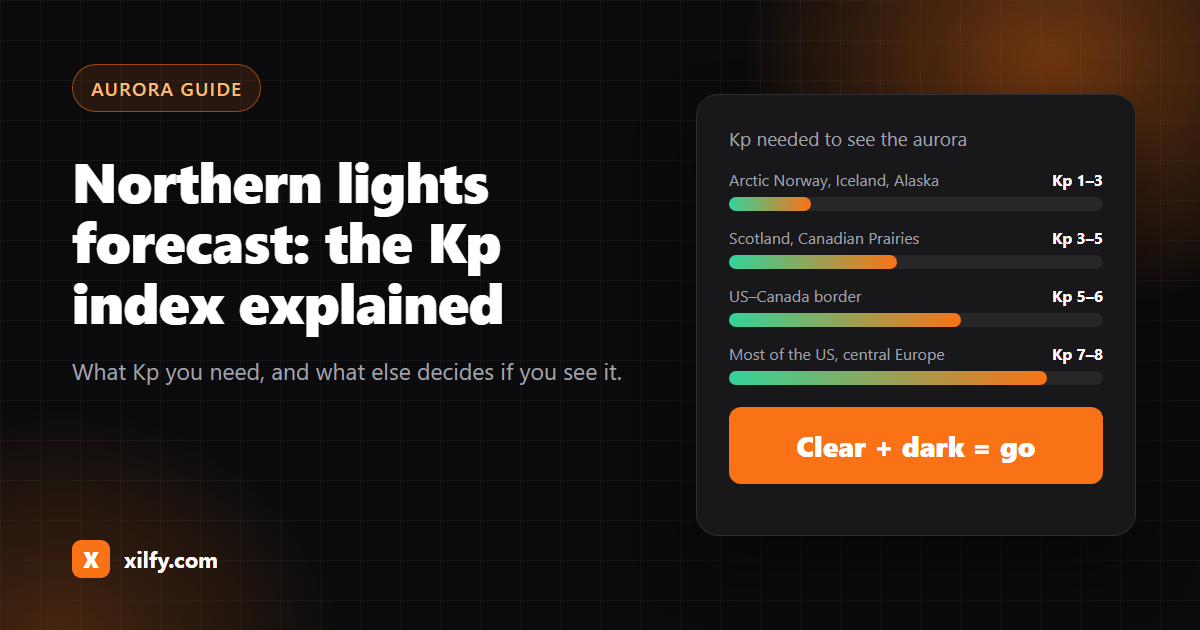
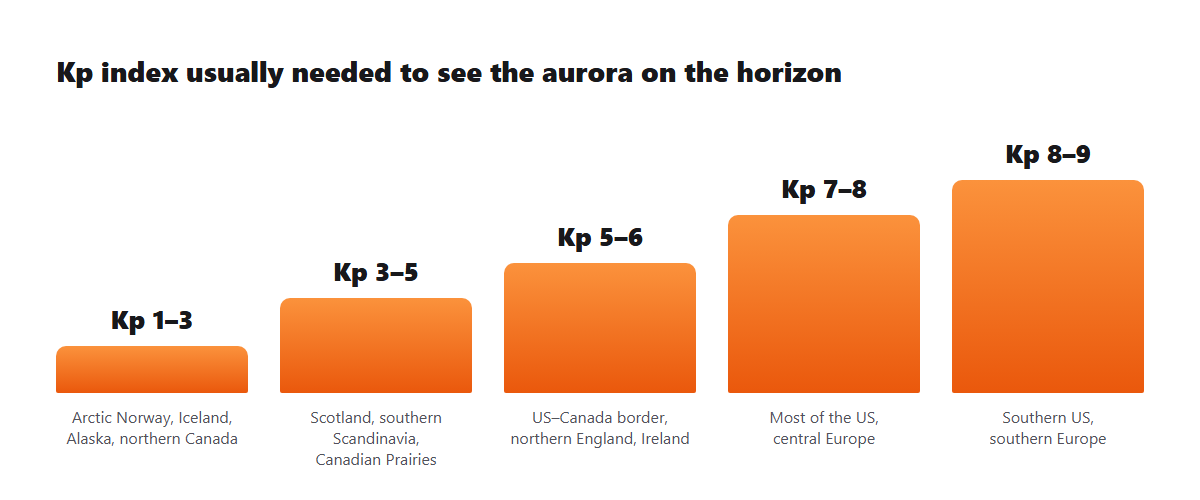
These are rough guides for seeing the aurora low on the northern horizon on a clear, dark night. If you want it overhead, add about 2 to 3 Kp.
| Where | Kp usually needed |
|---|---|
| Northern Norway, Iceland, Lapland, Alaska, northern Canada | 1–3 |
| Scotland, southern Scandinavia, the Canadian Prairies | 3–5 |
| Northern US border states, northern England, Ireland, the Baltic | 5–6 |
| Most of the northern US, southern England, central Europe | 7–8 |
| Southern US states and southern Europe | 8–9 (rare storms only) |
Our Northern Lights Tonight tool does this sum for your city. It compares the NOAA Kp forecast with your geomagnetic latitude, then gives you a plain yes, maybe or no.
Kp is only half the answer
A high Kp is wasted if you can't see the sky. Four other things decide whether you actually see the aurora:
- Darkness. The sun needs to be at least 12° below the horizon. In summer, places far north never get dark enough, which is why the aurora season in the Arctic runs roughly from late August to mid-April.
- Cloud cover. Thick low cloud hides everything. Check the cloud forecast for the hours you plan to be out, not the daily summary.
- The moon. A full moon washes out faint displays. A thin crescent or a moon below the horizon is ideal.
- Light pollution. Get away from street lights and face the pole: north in the northern hemisphere, south in the southern hemisphere.
Best time to look
- Hours: usually between about 10 pm and 2 am local time, but bursts can come at any time after dark.
- Months: activity tends to rise around the March and September equinoxes.
- The solar cycle: the Sun's 11-year cycle peaked around 2024–2025. Strong storms stay more likely for a few years after the peak, so the next couple of winters are still a good time to look.
Tips for seeing it
- Give your eyes 15–20 minutes in the dark, and keep your phone screen dim.
- Weak aurora often looks like a grey-white cloud to the eye. A phone camera on night mode shows the green much more clearly, so take a test shot.
- Don't give up after a quiet hour. Activity comes in waves called substorms that can light up the whole sky within minutes.
Frequently asked questions
What Kp do I need to see the northern lights?
It depends on where you are. Northern Norway, Iceland and Alaska can see the aurora at Kp 1–3. The US–Canada border usually needs Kp 5–6, and most of the US or central Europe needs Kp 7 or more.
Is Kp 5 good for the northern lights?
Kp 5 is a minor geomagnetic storm (G1). It is great news in Scotland, Scandinavia and Canada, and gives northern US states and northern England a real chance on a clear night.
How accurate are aurora forecasts?
The Kp forecast is reliable for a few hours ahead and less reliable two or three days out. Solar storms can arrive earlier or later than predicted and be stronger or weaker. Check again after dark.
Can I see the northern lights during a full moon?
Yes, during a strong display. A bright moon mainly hides faint aurora, so you need a higher Kp than usual to notice it.
Kp forecasts come from the NOAA Space Weather Prediction Center. The Kp guide in this post is approximate. Local conditions and the exact shape of each storm change what you see.
More guides
- How to Calculate Gas Cost for a Road Trip The three-number formula for fuel cost, a worked example, and why your real bill usually comes in 10–15% higher than the estimate.
- What Is a Good CPS? Clicks Per Second Explained Average CPS scores, what jitter, butterfly and drag clicking can reach, and simple ways to click faster without hurting your hand.
- The Schengen 90/180 Rule Explained, With Real Examples How the rolling 180-day window works, which countries count, and two worked examples so you never overstay in Europe by accident.