
Types of Color Blindness, Explained
Red-green and blue-yellow color blindness in plain English: what each type sees, how common it is, why men are affected more, and how to test yourself.
By The Xilfy Team Updated 4 min read
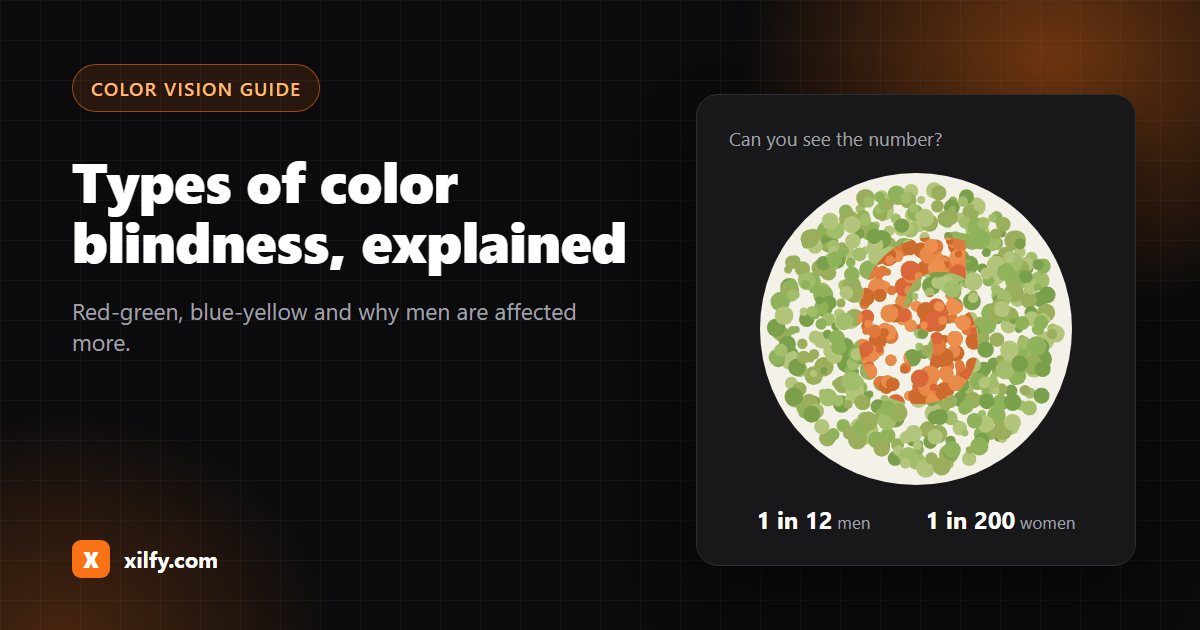 Try it: Color Blind Test
Read the numbers in generated dot plates to screen for red-green and blue-yellow color blindness
About 1 in 12 men and 1 in 200 women have some form of color blindness. Most of them can still see colors. They just mix up certain shades, usually reds and greens. Many people don't find out until a school eye test, a job medical, or a friend asks why they called a brown shirt green. This guide explains the main types, why men are affected more often, and how to test yourself.
How color vision works
Your retina has three kinds of cone cells, each tuned to a different part of the spectrum:
- L cones (long wavelengths), most sensitive to reddish light
- M cones (medium), most sensitive to greenish light
- S cones (short), most sensitive to bluish light
Your brain compares the signals from the three to work out color. When one type of cone is missing or works differently, some colors that look different to most people look the same.
The main types
Color blindness is named after the cone that is affected. -anomaly means the cone works but is shifted (milder). -anopia means the cone is missing (stronger).
| Type | Affected cone | What it's like | Men affected (approx.) |
|---|---|---|---|
| Deuteranomaly | Green (M), shifted | Greens look duller and closer to red. The most common type | ~5% |
| Deuteranopia | Green (M), missing | Reds and greens are hard to tell apart | ~1% |
| Protanomaly | Red (L), shifted | Reds look duller and darker | ~1% |
| Protanopia | Red (L), missing | Reds look dark, close to black or brown | ~1% |
| Tritanomaly / tritanopia | Blue (S) | Blues and greens, and yellows and pinks, get confused | Very rare |
| Achromatopsia | All cones | Sees almost no color at all | Extremely rare |
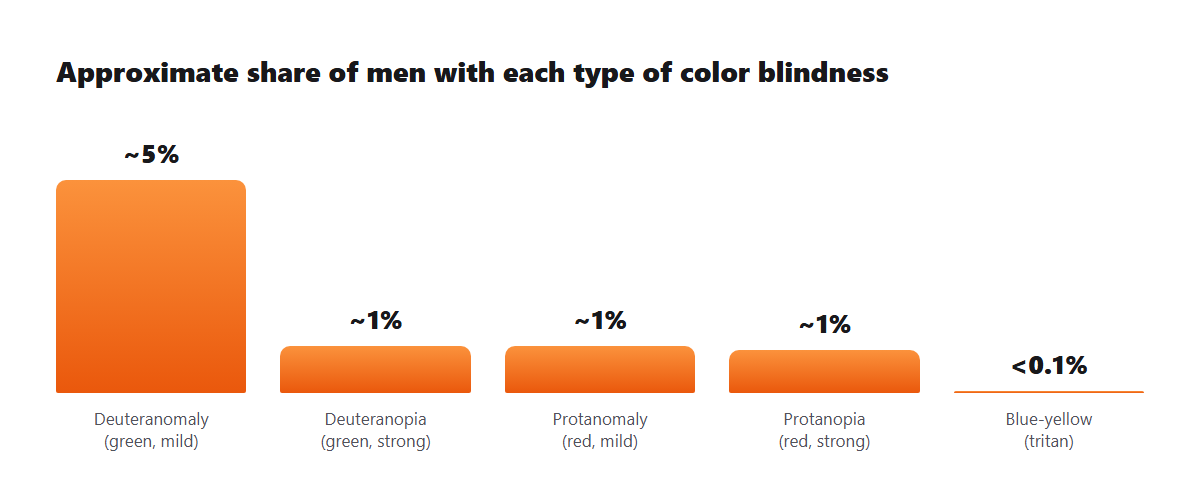
"Red-green color blindness" covers the first four types (protan and deutan). Together they make up the great majority of cases.
Why men are affected more
The genes for the red and green cones sit on the X chromosome. Men have one X chromosome, so a single changed gene is enough to cause red-green color blindness. Women have two X chromosomes, so the other one usually makes up for it. That is why about 8% of men of Northern European descent are red-green color blind, compared with about 0.5% of women. Rates are somewhat lower in many other populations.
Blue-yellow (tritan) color blindness is not linked to the X chromosome, so it affects men and women equally. It is also more likely to be acquired: it can develop with age, eye disease or some medicines.
What color blind people actually see
Seeing is easier than describing it. Our Color Blind Simulator shows any photo or chart the way it looks with each type. Here is deuteranopia, the classic red-green type. Designers use it to check that charts and buttons don't rely on red versus green alone.
Common everyday problems include:
- Telling ripe from unripe fruit, or rare from cooked meat
- Reading red and green status lights, charts and maps
- Matching clothes, especially browns, greens and purples
- Seeing red text or laser pointers on dark backgrounds
How to test yourself
The classic test uses dot plates: circles of colored dots with a number hidden inside, in colors that people with a particular type mix up. Our free Color Blind Test generates new plates for the red, green and blue cones, and tells you which type you may have and how strong it seems. It takes about two minutes.
For an accurate result:
- Turn off night mode, blue light filters and "true tone" or color-shifting features.
- Turn the screen brightness up and avoid strong glare.
- Answer quickly. Staring for a long time can make plates harder, not easier.
An online test is a good screening tool but not a diagnosis, because screens show color differently. If you fail plates, an optometrist or ophthalmologist can confirm it with calibrated tests.
Frequently asked questions
What is the most common type of color blindness?
Deuteranomaly, a mild weakness of the green cones. It affects about 5% of men.
Can color blindness be cured?
Inherited color blindness can't be cured. Special tinted glasses can make some colors stand out more for some people, but they don't restore normal color vision. Acquired color vision changes sometimes improve when the cause is treated.
Can women be color blind?
Yes, but far less often: about 1 in 200 women are red-green color blind, compared with about 1 in 12 men.
Can you be color blind in one eye?
Inherited color blindness affects both eyes. A difference between your eyes is more likely to be acquired, so mention it to an eye doctor.
Prevalence figures are approximate and mainly come from studies of people of Northern European descent. This guide is general information, not medical advice.
More guides
- How to Calculate Gas Cost for a Road Trip The three-number formula for fuel cost, a worked example, and why your real bill usually comes in 10–15% higher than the estimate.
- What Is a Good CPS? Clicks Per Second Explained Average CPS scores, what jitter, butterfly and drag clicking can reach, and simple ways to click faster without hurting your hand.
- The Schengen 90/180 Rule Explained, With Real Examples How the rolling 180-day window works, which countries count, and two worked examples so you never overstay in Europe by accident.