
UK Holiday Entitlement: How Much Paid Leave Are You Owed?
The 5.6-week rule in plain English, for full-time, part-time, zero-hours and irregular-hours workers, with tables and examples.
By The Xilfy Team 5 min read
 Try it: Holiday Entitlement Calculator
UK statutory annual leave for part-time, hours-based and irregular-hours workers, with pro rata
Almost every worker in the UK has a legal right to paid holiday. That includes part-time staff, agency workers and people on zero-hours contracts. But "how many days do I get?" has a different answer depending on how you work. This guide covers the statutory minimum, how it works for part-time and irregular hours, and the questions that come up most.
The short answer: 5.6 weeks
The legal minimum is 5.6 weeks of paid holiday a year. For someone working a standard five-day week, that is:
5 days × 5.6 weeks = 28 days
Two things surprise people about those 28 days:
- Bank holidays can be included. There is no legal right to have bank holidays off as extra paid leave. Many employers give 20 days plus the 8 bank holidays in England and Wales, which meets the minimum exactly.
- 28 days is a cap. If you work six days a week, 6 × 5.6 would be 33.6 days, but the statutory entitlement stops at 28. Your contract can give you more, and many do.
Part-time workers: same weeks, fewer days
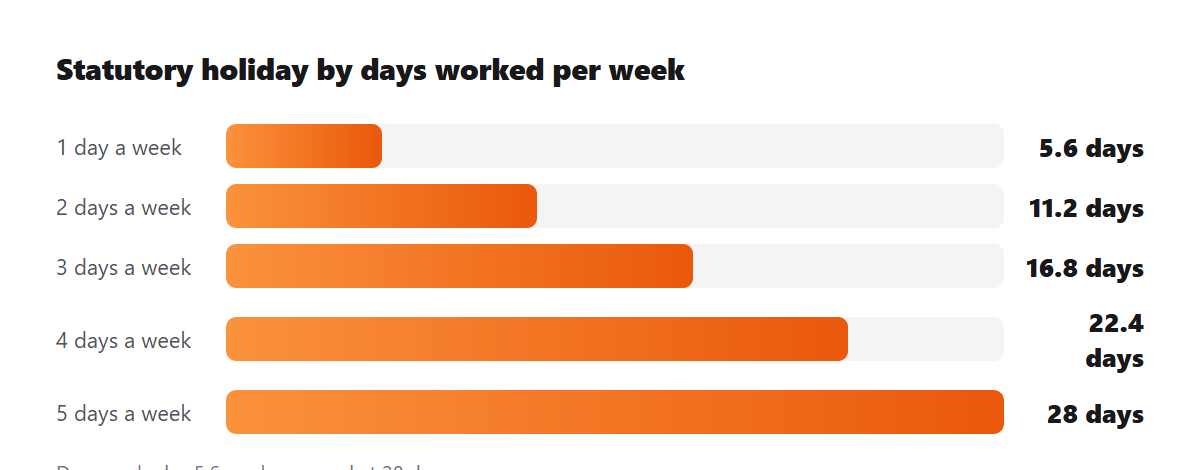
Part-time workers get the same 5.6 weeks, which simply means fewer days, because each week is shorter. Multiply the days you work each week by 5.6:
| Days worked per week | Statutory holiday |
|---|---|
| 1 day | 5.6 days |
| 2 days | 11.2 days |
| 3 days | 16.8 days |
| 4 days | 22.4 days |
| 5 days | 28 days |
Employers can round up, but they cannot round down. 16.8 days can become 17, but not 16.
If your days vary in length, it is fairer to work in hours. Someone working 24 hours a week gets 24 × 5.6 = 134.4 hours of paid holiday a year.
One thing to watch: if bank holidays fall on days you don't work, you should not lose out. A part-timer who never works Mondays still gets their full 5.6 weeks. Bank holidays that land on their non-working days simply don't come out of their allowance.
Our holiday entitlement calculator works this out for days or hours, including part-year starters.
Irregular hours and zero-hours contracts
If your hours change from week to week, such as zero-hours, casual or term-time work, a fixed number of days doesn't make sense. For leave years starting on or after 1 April 2024, the law gives irregular-hours and part-year workers a simpler method:
You build up holiday at 12.07% of the hours you actually work in each pay period.
Work 100 hours in a month and you earn 12.07 hours of paid holiday. Work 1,000 hours over a year and you have earned 120.7 hours.
Why 12.07%? It is 5.6 weeks of holiday divided by the 46.4 weeks of a year you are actually working (52 − 5.6), so 5.6 ÷ 46.4 = 0.1207.
For these workers, employers may also use rolled-up holiday pay: an extra 12.07% added to every payslip instead of paying you when you take time off. If your employer does this, it must appear as a separate line on your payslip.
Starting or leaving part-way through the year
If you start a job mid-year, you get a pro-rata share of the year's holiday. Join with six months of the leave year left on a five-day week, and your statutory minimum for that year is 14 days.
When you leave, you are entitled to pay for any statutory holiday you have built up but not taken. If you have taken more than you have built up, your contract may allow your employer to deduct the difference from your final pay. It can only do so if the contract says so.
Can I carry holiday over?
Generally, statutory holiday is meant to be used in the leave year it belongs to. The main exceptions:
- Your contract allows it. Many employers let you carry a few days over.
- You couldn't take it because of sickness, or maternity, paternity, adoption or other family leave. In that case you can carry leave forward.
- Your employer stopped you taking it, or didn't tell you about your right to it. Then the leave is not lost.
Holiday pay: what you should be paid
You should be paid your normal pay while on holiday. For many people that is simply their usual salary. If your pay varies, normal pay is based on your average over the previous 52 paid weeks, and it should include regular overtime and commission, not just basic pay.
Frequently asked questions
Do I get holiday on a zero-hours contract?
Yes. All workers build up paid holiday, whatever their contract says. For leave years from 1 April 2024, irregular-hours workers usually accrue it at 12.07% of hours worked.
Can my employer tell me when to take holiday?
Yes, as long as they give the right notice. That is normally at least twice as many days' notice as the length of the holiday they want you to take. They can also refuse a request with notice equal to the length of the leave you asked for.
Do bank holidays count towards my 28 days?
They can. Employers may include the 8 bank holidays in England and Wales within the 28-day minimum. Your contract tells you whether they are included or on top.
Is 28 days the most I can get?
No. 28 days is the statutory minimum for a five-day week (and the cap on the statutory part). Your contract can give you more.
Checked against the Working Time Regulations 1998 and GOV.UK's guidance on holiday entitlement, November 2026. This guide covers the statutory minimum in Great Britain; Northern Ireland has its own regulations with similar rules. It is general information, not legal advice. For a dispute with an employer, contact Acas for free, impartial help.
More guides
- How to Calculate Gas Cost for a Road Trip The three-number formula for fuel cost, a worked example, and why your real bill usually comes in 10–15% higher than the estimate.
- US Sales Tax by State: How It Works and How to Calculate It Why the price on the shelf isn’t what you pay, which states charge the most and least, and the simple formula for any purchase.
- The Schengen 90/180 Rule Explained, With Real Examples How the rolling 180-day window works, which countries count, and two worked examples so you never overstay in Europe by accident.