
US Sales Tax by State: How It Works and How to Calculate It
Why the price on the shelf isn’t what you pay, which states charge the most and least, and the simple formula for any purchase.
By The Xilfy Team 4 min read
 Try it: Sales Tax Calculator
Add or remove US sales tax with 2026 state and local rates for every state
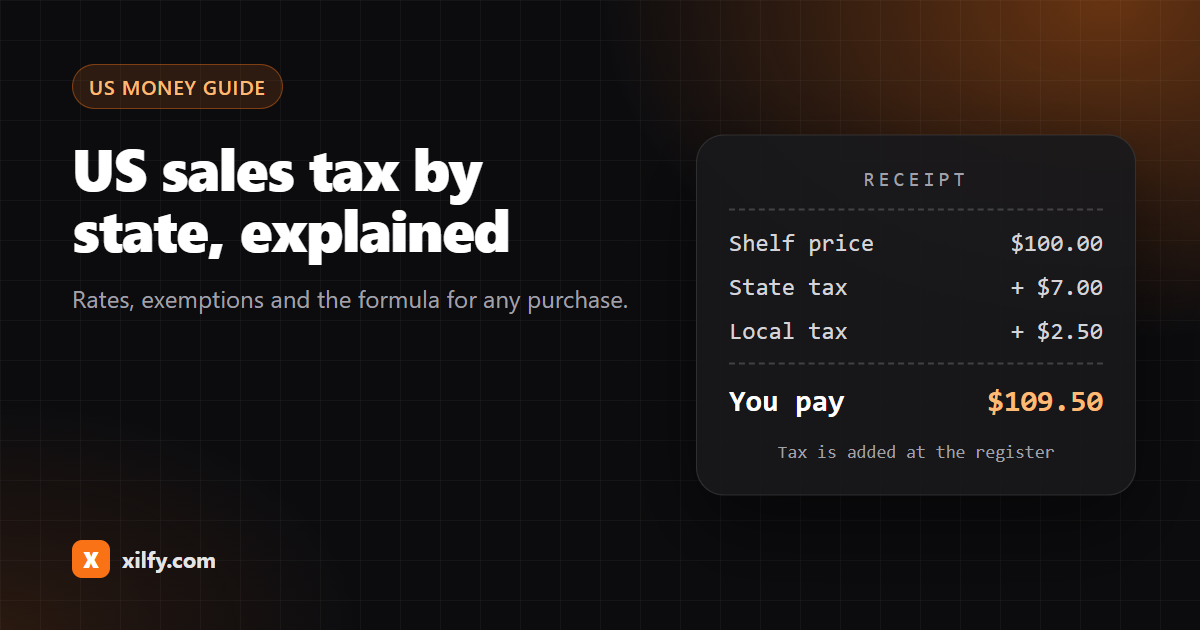
Visitors to the US are often caught out at the till: the price on the shelf is not the price you pay. Sales tax is added at checkout, and the rate depends on the state, the county and often the city you're standing in. This guide explains how it works, which states charge the most and the least, and how to work out the tax on any purchase in seconds.
How US sales tax works
Unlike VAT in the UK or Europe, US sales tax is:
- Not included in the price tag. It is added when you pay.
- Set locally, not nationally. There is no federal sales tax. Each state sets its own rate, and most let counties and cities add their own on top.
- Charged where you take delivery. Buy in a store, and you pay that location's rate. Order online, and you usually pay the rate where the item is delivered.
The rate you actually pay is the combined rate: state + county + city (+ any special district). That is why two shops 10 miles apart can charge different amounts for the same item.
The five states with no statewide sales tax
Five states do not charge a statewide sales tax:
| State | Average combined rate |
|---|---|
| Delaware | 0% |
| Montana | 0% (some resort towns add a local tax) |
| New Hampshire | 0% |
| Oregon | 0% |
| Alaska | 1.82% (no state tax, but many local governments charge one) |
Alaska is the exception that catches people out. There is no state tax, but boroughs and cities can charge their own, and some local rates are as high as 7.85%.
The highest combined rates
These states have the highest average combined state and local rates (Tax Foundation, midyear 2026):
| State | State rate | Average combined rate |
|---|---|---|
| Louisiana | 5% | 10.13% |
| Tennessee | 7% | 9.61% |
| Washington | 6.5% | 9.57% |
| Arkansas | 6.5% | 9.48% |
| Alabama | 4% | 9.46% |
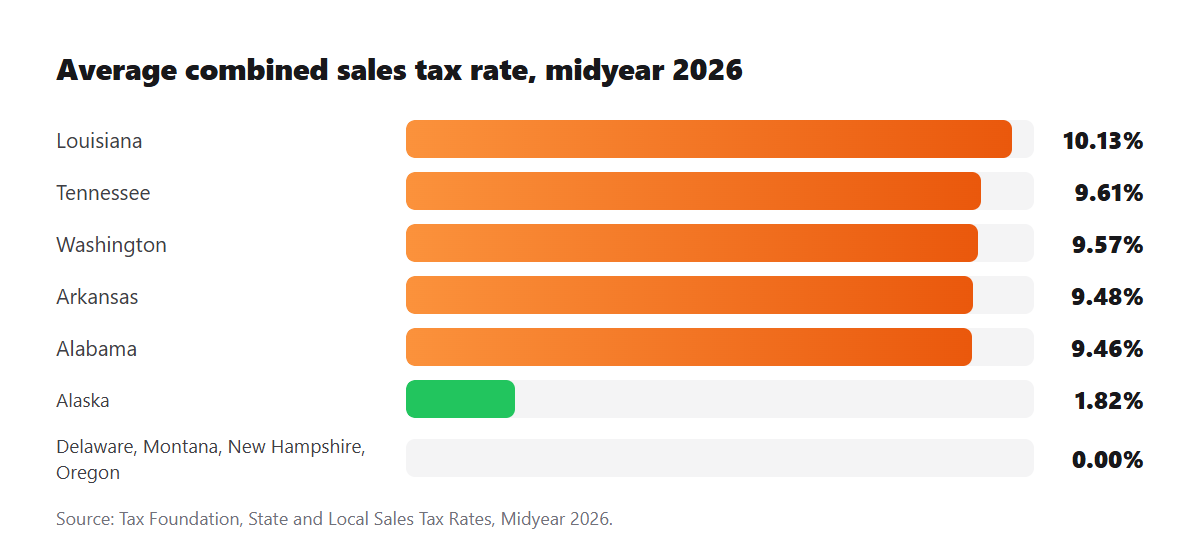
Note how Louisiana and Alabama top the list despite modest state rates. Their parishes, counties and cities add large local taxes. The highest state rate belongs to California at 7.25%, which includes a mandatory local add-on. Indiana, Mississippi, Rhode Island and Tennessee follow at 7%.
You can look up every state's state, average local and combined rate in our sales tax calculator, which also has a page for each state.
How to calculate sales tax
The maths is the same everywhere:
Tax = price × rate Total = price × (1 + rate)
Example: a $250 TV in Indiana, where the rate is a flat 7% statewide.
- Tax: $250 × 0.07 = $17.50
- Total: $250 + $17.50 = $267.50
Working backwards from a receipt
If you know the total and want the price before tax, divide instead of subtracting:
Price before tax = total ÷ (1 + rate)
A $107.00 receipt at 7% means a pre-tax price of $107 ÷ 1.07 = $100.00. Subtracting 7% of $107 ($7.49) would give the wrong answer, $99.51.
What usually isn't taxed (or is taxed less)
Every state writes its own list, but some patterns are common:
- Groceries. Many states exempt basic groceries or tax them at a lower rate. Tennessee, for example, taxes groceries at a reduced 4% state rate plus the local rate.
- Prescription medicine is exempt almost everywhere.
- Clothing is exempt in a few states, sometimes only below a price limit.
- Services, such as haircuts or repairs, are taxed in some states and not in others.
Several states also run sales tax holidays, often a back-to-school weekend in late summer, when clothing and school supplies under a set price are tax-free.
Buying online
Since a 2018 Supreme Court decision (South Dakota v. Wayfair), states can require online sellers to collect sales tax even if the seller has no shop there. Today, nearly all large retailers and marketplaces charge the tax for your delivery address at checkout.
If a seller doesn't collect it, you technically owe use tax to your state at the same rate. Most states let you report it on your income tax return.
Frequently asked questions
Which state has the lowest sales tax?
Delaware, Montana, New Hampshire and Oregon have no statewide sales tax and almost no local sales tax, so most purchases there are tax-free. Alaska has no state tax, but local rates apply in many areas.
Why is the rate in my city higher than the state rate?
Because counties, cities and special districts add their own taxes on top of the state rate. The combined total is what you pay.
Do tourists get sales tax refunds in the US?
Generally, no. Unlike VAT in Europe, US sales tax is not refunded to international visitors. Louisiana historically ran a tourist refund programme, so check the state's current rules before relying on it.
Is sales tax the same as VAT?
No. VAT is charged at every stage of production and is usually included in the price you see. US sales tax is charged once, to the final buyer, and added at checkout.
Rates from the Tax Foundation's "State and Local Sales Tax Rates, Midyear 2026". Local rates change often, so for an exact figure at a specific address, check the state's department of revenue. This guide is general information, not tax advice.
More guides
- How to Calculate Gas Cost for a Road Trip The three-number formula for fuel cost, a worked example, and why your real bill usually comes in 10–15% higher than the estimate.
- UK Holiday Entitlement: How Much Paid Leave Are You Owed? The 5.6-week rule in plain English, for full-time, part-time, zero-hours and irregular-hours workers, with tables and examples.
- The Schengen 90/180 Rule Explained, With Real Examples How the rolling 180-day window works, which countries count, and two worked examples so you never overstay in Europe by accident.